- Updated on December 10, 2020
 By Dr. Artour Rakhimov, Alternative Health Educator and Author
The goal of the Buteyko method is to bring about breathing in accordance with internationally accepted medical and physiological norms and standards. Practically, the method is intended to eliminate chronic alveolar hyperventilation (or breathing too much) and to restore the normal balance between carbon dioxide and oxygen in the lungs, blood, and all cells.
Dr. Artour’s video about the qualities of the ideal Buteyko course:
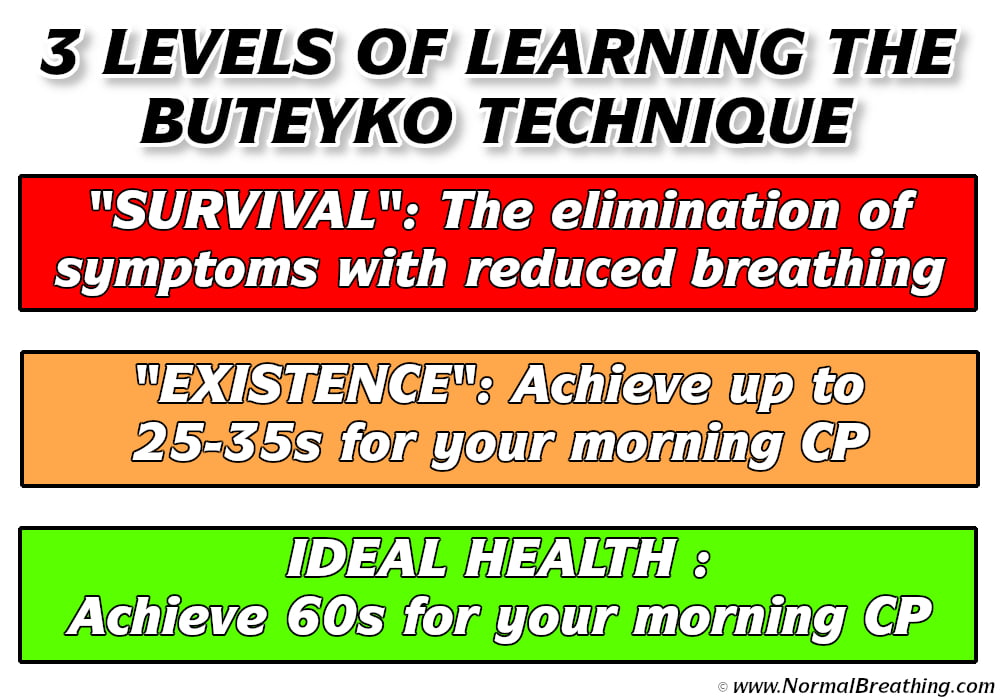
3 levels of learning the Buteyko technique
* Level 1 “Survival”. The student is able to eliminate the main symptoms of own health problems (e.g., asthma, heart disease, epilepsy, sinusitis, eczema, insomnia, constipation, etc.) using the Emergency Procedure so that the Emergency Procedure can substitute the use of medication or significantly reduce the dosage (e.g., twice). Such students have low CP s (usually about 5-15 s), while elimination or reduction in medication is their main practical result. Only about 10% of learners or less are satisfied with this level. It takes about 1-2 days to learn.
* Level 2 “Existence”. The student partly normalized own breathing until about 25-35 s CP, so that he has no need for medication and does not experience the symptoms of his main health problem, e.g., asthma, bronchitis, heart disease, epilepsy, sinusitis, eczema, etc. However, such a learner can still suffer from airways inflammation, allergies, GI problems, hormonal problems, and musculoskeletal problems. Various medical drugs can be required to control symptoms of these “high-CP” diseases, This is the level achieved by most people on the west. It takes about 1- 3 months to learn.
* Level 3 “Normal health”. The student has no less than 60 s at any moment of the day. Such CPs provide the guarantee about the absence of pathologies and symptoms related to many degenerative health conditions (over 150 so-called “diseases of civilization”). Achievement of this level requires willpower, self-discipline, determination and excellent knowledge of the Buteyko method. There are many students worldwide (and thousands in Russia) who got there and none has regrets about the time and energy spent. The final goal of the method for Level 3 is normalization of breathing. Among parameters of normal breathing, according to Doctor Buteyko, are: 60 s CP (breath holding time at rest, after quiet expiration, with no stress at the end of test); 4 l/min ventilation rate (for a 70-kg man); and 6.5% CO2 (about 46 mm Hg CO2 at sea level) in alveoli and arterial blood. As we can see here, his parameters are more rigorous than typical medical and physiological norms: 40 s CP; 6 l/min; 40 mm Hg at sea level (or about 5.3%). Most people can achieve this level, while following the ideal specially tailored program, within 2-5 months, but for severely sick people it often takes 0.5-2 years to get there.
You can find more details about these 3 levels and how I teach these levels to my students (during live courses and online) here: Artour’s breathing courses.
Learning options: taking a course, from a book or DVD, or the do-it-yourself way?
The Buteyko method usually includes 2 parts: breathing exercises to be practiced by the patient (about 1 hour per day at least) and common sense activities that reverse chronic hyperventilation (e.g., breathing only through the nose, prevention of over-eating, prevention of sleeping on the back, etc. )
Learning in a group from an experienced teacher (who knows how to get 60 s CP) is the optimum way. Ask your teacher if he or she knows how to get CP 60. If they do not have it (and therefore do not know the way to CP 60), you can still get about CP 30-40 while learning from a teacher or in a group. There are only a few experienced teachers in Canada and the USA (and tens of new ones), but hundreds in the UK or Australia. Why? Because it was introduced in Australia about 15 years ago, in the UK about 10 years ago, and about 5 years ago in the USA and Canada.
Learning from a book or DVD is possible but not easy for most people since Buteyko exercises are quite complicated and challenging to execute correctly. However, if you achieve up to 25-30 s CP using breathing devices, then learning Buteyko exercises is easy.
This site provides more information about the Frolov breathing device and Amazing DIY breathing device, as well as details of the Buteyko exercises and lifestyle changes.