- Updated on October 29, 2020
 By Dr. Artour Rakhimov, Alternative Health Educator and Author
- Medically Reviewed by Naziliya Rakhimova, MD
(This is Part 2 of Module 10. Buteyko breathing exercises)
For your education, it is important to know why relaxed diaphragmatic breathing is essential for oxygen transport and health, and how to acquire abdominal automatic (unconscious) breathing 24/7 by changing your breathing pattern. It is also important to know why over 97% of modern yoga teachers do not know and do not teach effective methods to their students. These topics are discussed here: Diaphragmatic breathing instructions
 This web page is not “breathe 2 relax app” or “breathe 2 relax Android” app. This page provides instructions for the safest diaphragmatic breathing exercise (relaxed diaphragmatic breathing) for people with hypertension and other forms of heart disease to lower their heart rate (pulse) and gradually reduce their blood pressure. Bear in mind that most hypertensives, when they have less than 20 s for the body oxygen test, are not able to get benefits from regular Buteyko breathing exercises that involve breath holds and reduced breathing.
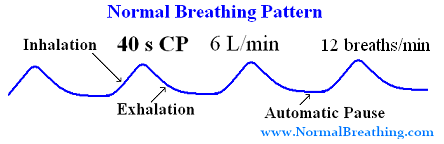
Healthy people (over 40 s for the CP test or the body-oxygen test) naturally have diaphragmatic breathing at rest. This graph below shows the normal breathing pattern. Each cycle has a tiny inhalation (the upward straight lines), exhalation (the curved downward lines) and automatic pause (the almost- horizontal lines) accompanied by the relaxation of all breathing muscles.
If the CP (body-oxygen content) is about 20 s or less, as is the case with sick people, the typical breathing pattern is the following:
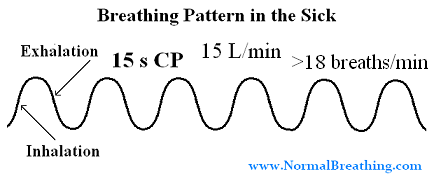
The inhalations are bigger (deeper); breathing is faster (higher frequency); exhalations are forceful (not relaxed), and there is no automatic pause.
 Warning. It is a serious mistake and a waste of time to practice normal breathing if your CP is less than 25 s. Why? People start to breathe deeply, while during normal breathing inhalations are tiny (normal breathing is invisible). Dr. Buteyko noticed this effect over 40 years ago (his quote is a few lines below). In fact, you will learn soon that reduced breathing, the main part of the Buteyko breathing exercises, is more shallow and, for sick people, more frequent.
“The breathing [retraining] should be monitored by an instructor who had learned the method himself. Our instruction of 1964 was published in Novosibirsk, 1000 issues. We still were naive and thought that after reading this correct instruction, the patient would be able to reduce breathing and then compare when it is normal. It [the instruction] included the information about normal breathing: 2 s for inhalation, 3 s for exhalation, 3 s for the pause, etc. First, he [the student] starts to breathe deeply, secondly, he immediately tries to fulfill that normal breathing. All [final] effects are the opposite, even [for] a [medical] doctor.” Dr. Buteyko, Public Lecture in the Moscow State University, 1969.
You can discover one great method that leads to much faster learning of diaphragmatic breathing. I tested this method on hundreds of my students with great results. The name of this technique is provided right below here (in the next paragraph), as your bonus content.
You need to use the breathing devices, like the Amazing DIY breathing device or the Frolov device.
[/sociallocker]
Relaxing breathing muscles and abdominal respiration
 This big and deep breathing usually makes chest muscles to do the main job of air pumping. Why? Low CO2 content makes the diaphragm tense. Coupled with slouching, a lack of CO2 restricts diaphragmatic movements making chest breathing the typical feature of people with low CPs.
If you have been using mostly your chest muscles for breathing at rest during the last 5-10 or more years, it would take some days or weeks to restore the normal diaphragmatic breathing.
The process of learning to unblock the diaphragm is divided into 4 stages:
Stage 1: Feeling the breath
Stage 2: Relaxation of the body’s muscles
Stage 3: Tensing and relaxing breathing muscles
Stage 4: Relaxed diaphragmatic breathing.
Stage 1: Feeling the breath
Focus on your usual breathing for 2-3 minutes at rest while sitting with a straight spine. What do you feel? If the sensations are vague, take a deep slow in-breath and slowly exhale. Do you feel how the airflow goes through your nostrils? Do you have any sensations at the back of your throat? Are there any feelings about the movement of air inside the chest and bronchi? What do you sense near your stomach?
 Usually, children have a good perception of their own breathing. Older people notice fewer sensations. Having these sensations makes the process of learning easier. However, even if the student feels nothing at all (rare, but possible), it is still possible to learn the method. How? First, the student can restore the sensations by doing special exercises and focusing his attention on his own breathing. Second, if these exercises do not work, as in very rare cases, the teacher can use, for the right students, special breathing exercises that do not need the feeling of one’s breath.
To restore the sensations of your own breath, the following exercises can be used.
1. Put your hands around your waistline, as if embracing yourself, and listen to your usual breathing for about 20-30 seconds. You will be able to detect the movements of the diaphragm.
2. Put your hands slightly above the waist (about 10 cm or 4 inches higher) around your waist and listen to your usual breathing for about 20-30 seconds. You will be able to detect the movements of the rib cage.
In most cases, repeating these exercises a few times will solve the problem. If the sensations are still not present, the student should practice the exercise with the books and the exercise with the belt described below.
Stage 2: Relaxation of the body’s muscles
 The student is asked to tense some parts of his body muscles and then relax them. This is usually not a problem for a particular arm or leg but is more difficult when more muscles are involved. To learn tension and relaxation of the whole body gradually, the student can start with some muscles and then add other groups. For our future goals, the student should be able:
– to tense the whole body and then relax it;
– to tense the upper part of the body (from the rib cage up) and then relax it.
Stage 3: Tensing and relaxing breathing muscles
As a next logical step, the student tries to tense and relax breathing muscles, which we divide, for our purposes, into 2 groups:
– the diaphragm (other names are “tummy”, “belly”, and “stomach”);
– all remaining breathing muscles (other names are “chest muscles”, “rib cage muscles”, and “thoracic muscles”).
Here all these muscles are tensed and relaxed together. In order to achieve success, do the following simple exercise. Close the mouth and stop breathing through the nose (using our throat lock mechanism). Try to take a strong and big inhale, while there is no way for the air to move into the lungs. This helps to achieve a strong sensation of tension in the breathing muscles. Keep the tension for 1-2 seconds and then relax the muscles and take a light inhalation.
Stage 4: Relaxed breathing using the diaphragm
Can you breathe for 1-2 minutes using the tummy or stomach only? If you are uncertain or your sensations are absent or vague, it is necessary to review Module 8: How to develop diaphragmatic breathing 24/7
After the student is able to breathe using mainly the diaphragm, the next step is to learn how to relax it during exhalations. Each exhale should be accompanied by the relaxation of all bodily muscles. The changes in the breathing pattern for a person with the low initial CP, who practices relaxation of the diaphragm only (no deliberate air hunger), are shown below.
Relaxed Abdominal Respiration for Hypertension and Low-CP students
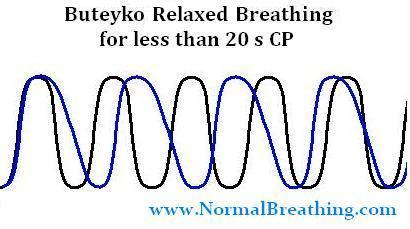
Your breathing before this exercise is shown using the black line (with forceful exhalations). During this exercise, you should unblock the diaphragm. You have the following goal: take your usual inhalation using your diaphragm only and then relax your diaphragm for exhalation. This will make your exhalations smooth (the blue line for your new breathing pattern). Note that the depth of your inhalations remains the same, but the frequency of your breathing becomes smaller. Hence, reduced breathing for low CP students is achieved using relaxation only. If you do this exercise correctly, you should notice that your pulse or heart rate is lower after the session.
For most people, this is a transitory (temporary) exercise. (Heart and hypertension patients should stick with this exercise until they get over 20 s CP and reduce or lower their high blood pressure to normal levels without medication.) Practice this exercise for 2-3 minutes so that you get a clear sensation of your relaxed diaphragmatic exhalation. (You can or even should wear the belt during this exercise if you are not sure about your ability to breathe using your diaphragm only. The belt will prevent you from having any chest breathing. Its use is described in Module 8.)
Note. On this site, you can get my PDF book “Advanced Buteyko Breathing Exercises” (about 124 pages, 12 USD). Read happy and great reviews of this book on Amazon.com. This book considers effects of overtraining, lost CO2 sensitivity, blunted CO2 sensitivity, “click” effect, “Steps” breathing exercise for walking, Buteyko breathing exercises during physical activity, etc.