- Updated on November 1, 2020
 By Dr. Artour Rakhimov, Alternative Health Educator and Author
 Graded exercise therapy (GET) is physical exercise program that increases the duration and intensity of exercise slowly and gradually. This clinical approach has been used for many decades for chronic fatigue syndrome (CFS), heart failure, chronic back pain, diabetes and many other conditions.
A typical program of graded exercise therapy starts with 5 minutes walking every other day for 1 or 2 weeks. If the person feels improvement, he can add up to 5 more minutes to his exercise for the next 1 or 2 weeks.
Clinical trials of graded exercise therapy for chronic fatigue reported moderate improvement (Tench et al, 2005) or inconclusive results (Ridsdale et al, 2004).
 Furthermore, some reviews suggested that graded exercise therapy can be harmful to chronic fatigue patients (Twisk & Maes, 2009). Why do we have this confusion?
Over 150 Russian doctors tested thousands of their patients and found that physical exercise with mouth breathing is a great threat to health since it usually causes exacerbations of symptoms and feeling worse after exercise. These health professionals confirmed that exercise become safe and effective when the person has nose-only breathing during physical exercise.
Effects of graded exercise therapy
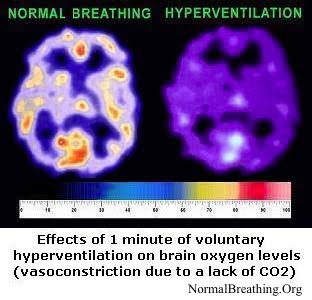
 Since over 98% of modern people exercise with mouth breathing and believe that breathing more is good, it is clear that such a graded exercise therapy will produce poor effects on brain and body oxygenation. Sick people are generally unable to get benefits from graded exercise therapy with oral breathing.
In contrast, nose breathing allows the utilization of nitric oxide (produced in sinuses) and increases alveolar CO2 that improves oxygen transport profoundly improving biochemistry of the human body and decreasing one’s heart rate.
If graded exercise therapy is done with strictly nasal breathing (in and out), patients can avoid the following negative after-effects of exercise with mouth breathing: anaerobic cellular respiration, elevated blood lactate, oxidative stress or the production of free radicals, chronic inflammatory response, and the over-expression of hypoxia inducible factor-1. For more details, visit the web page devoted to effects of exercise on the respiratory system (see the link below).
According to over 150 Russian MDs practicing the Buteyko breathing method in Russia, physical activity with nose breathing is safe even for sick people with chronic fatigue or fibromyalgia. It should be increased very gradually in order to be the central factor of graded exercise therapy that helps people to develop light and easy automatic breathing at rest (i.e., normal breathing) and increase body-oxygen levels.
Another finding of Russian doctors is that sick people with less than 20 s for the body-oxygen test (with fibromyalgia or chronic fatigue as well) cannot exercise rigorously with nose breathing (e.g., during running). Therefore, they should exercise easier and start walking as an initial phase of their graded exercise therapy. With more than 20 s of oxygen in the body, people can start running with nose breathing in and out, as their final part of graded exercise therapy.

References
Psychol Med. 2004 Jan;34(1):37-49.
Is graded exercise better than cognitive behavior therapy for fatigue? A UK randomized trial in primary care.
Ridsdale L, Darbishire L, Seed PT.
Department of Neurology, Guy’s, King’s and St Thomas’s School of Medicine, London.
BACKGROUND: Patients frequently present with unexplained fatigue in primary care, but there have been few treatment trials in this context. We aimed to test cognitive behavior therapy (CBT) and graded exercise therapy (GET) for patients presenting to their family doctor with fatigue.
Secondly, we described the outcome for a cohort of patients who presented to the same doctors with fatigue, who received standard care, plus a booklet…
… CONCLUSIONS: Short courses of GET were not superior to CBT for patients consulting with fatigue of over 3 months in primary care. CBT was easier ‘to sell’. Low recovery in the CFS subgroup suggests that brief treatment is too short.
Rheumatology (Oxford). 2003 Sep;42(9):1050-4. Epub 2003 Apr 16.
Fatigue in systemic lupus erythematosus: a randomized controlled trial of exercise.
Tench CM, McCarthy J, McCurdie I, White PD, D’Cruz DP.
National Sports Medicine Institute, The London NHS Trust, London, UK.
… CONCLUSION: These findings support the use of appropriately prescribed graded aerobic exercise in the management of patients with fatigue and systemic lupus erythematosus.
Neuro Endocrinol Lett. 2009;30(3):284-99.
A review on cognitive behavioral therapy (CBT) and graded exercise therapy (GET) in myalgic encephalomyelitis (ME) / chronic fatigue syndrome (CFS): CBT/GET is not only ineffective and not evidence-based, but also potentially harmful for many patients with ME/CFS.
Twisk FN, Maes M.
ME-de-patiënten Foundation, Limmen, the Netherlands.