- Updated on August 3, 2026
 By Dr. Artour Rakhimov, Alternative Health Educator and Author
- Medically Reviewed by Naziliya Rakhimova, MD
Proper Breathing Techniques for Body Oxygenation, Health, and Fitness
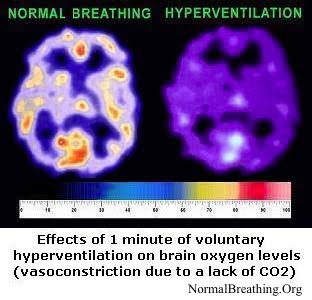 One can spend months or years practicing some breathing exercises, but if one’s automatic (unconscious) breathing pattern (e.g., during sleep) remains the same, there are no improvements in health, symptoms, and quality of life. Hence, the goal of correct respiratory exercises is to achieve very slow and easy breathing (to breathe less 24/7).
There are also some other less known or less common breathing exercises. They include breathing techniques for labor or childbirth (Lamaze breathing techniques), breathing techniques for running, singing, speaking, swimming, meditation, stress, and many others. There is even a breathing technique to help horses. In addition, there are web pages devoted to reviews of respiratory trainers (such as Powerbreathe, Expand-A-Lung, PowerLung, and Ultrabreathe). These respiratory exercises are used to train inspiratory muscles, but the effects of these devices depend on methods and instructions for their application.
Proper Breathing techniques
| Hatha yoga | Pursed lip breathing | Strelnikova breathing gymnastic | Buteyko breathing method | Frolov breathing device | RESPeRATE guided- breathing device | |
| When created | Prior to 16-th century | Before 1910 | Late 1930s-early 1970s | 1960’s | 1990’s | 1990’s |
| Who created | Yogi Swatmarama | Patients | Alexandra Nikolaevna Strelnikova | Konstantin Pavlovich Buteyko | Vladimir Frolov & Eugeniy Kustov |
Benjamin Gavish |
| Major publications | “Hatha Yoga Pradipika” by Yogi Swatmarama | Many articles and trials | “Strelnikova breathing gymnastic” by Michael Schetinin (in RUS) | Many books, articles and trials | “Endogenous breathing: medicine of the third millennium” by Vladimir Frolov (in RUS) | – |
| Patents and applications | None | None | USSR,1972 | Applications and patents | USSR,1991; Russia,1998 USA,1998 | USA, 1998 |
| Number of students | Many tens of millions | >100,000 (worldwide) | >50,000 (mainly in Russia) | >500,000 (half in Russia) | >1,000,000 (over 95% in Russia) | 100,000 (in western countries) |
| Which conditions | Chronic diseases | COPD, asthma, asthma in children, emphysema, stroke, autonomic failure, primary hypertension, major abdominal surgery, cystic fibrosis, myasthenia gravis, myotonic muscular dystrophy, autonomic failure | Some chronic diseases | Chronic diseases | Chronic diseases | Hypertension |
| Clinical trials | Numerous, worldwide | Numerous, worldwide |
No trials, but some MDs’ reports | Numerous, worldwide |
Numerous, Russia | 10 western clinical trials |
 Note that the “Russian dominance” in this Table reflects the current situation related to the popularity of some proper breathing techniques in Russia. For example, over 2,000,000 Frolov breathing devices were sold there during the first decade of the 21st century in pharmacies. Furthermore, Russia is probably the only country in the world where the general population believes and knows that the slower and less you breathe, the better your health is. This is due to the public activities and clinical work of leading Soviet physiologist Konstantin Buteyko, MD, Ph.D., and about 600 Russian medical doctors who teach breathing techniques. Russia has more doctors that teach respiratory methods than the number of doctors in the rest of the world.
Natural lifestyle choices before and after breathing retraining
| Lifestyle factor: | Body oxygen < 30 s | Body oxygen > 50 s |
| Energy level | Medium, low, or very low | High |
| Desire to exercise | Not strong, but possible | Craving and joy of exercise |
| Intensive exercise with nose breathing | Hard or impossible | Easy and effortless |
| Typical mind states | Confusion, anxiety, depression | Focus, concentration, clarity |
| Craving for sugar and junk foods | Present | Absent |
| Addictions to smoking, alcohol, and drugs | Possible | Absent |
| Desire to eat raw foods | Weak and rare | Very common and natural |
| Correct posture | Rare and requires efforts | Natural and automatic |
| Sleep | Often of poor quality; > 7 hours | Excellent quality; < 5 hours naturally |
How to choose proper respiratory techniques?
 Proper respiratory exercises should satisfy certain criteria in order to be useful for the health of the breathing retraining student. One of the things to consider is that the general approach of any breath technique should take our 24/7 automatic or unconscious breathing pattern into consideration, and not only suggest doing some breathing exercises.
In other words, what is the point of doing respiratory exercises, if you sleep with your mouth open and on your back every night? One can practice the best breathing exercises for several hours every day, but one can still die from the advance of cancer, heart disease, diabetes, asthma, bronchitis, or other chronic diseases due to the Sleep Heavy Breathing Effect, which is the main triggering factor leading to acute episodes (exacerbations) and deaths in the severely sick.
This Table explains why sick people have low body-oxygen levels.
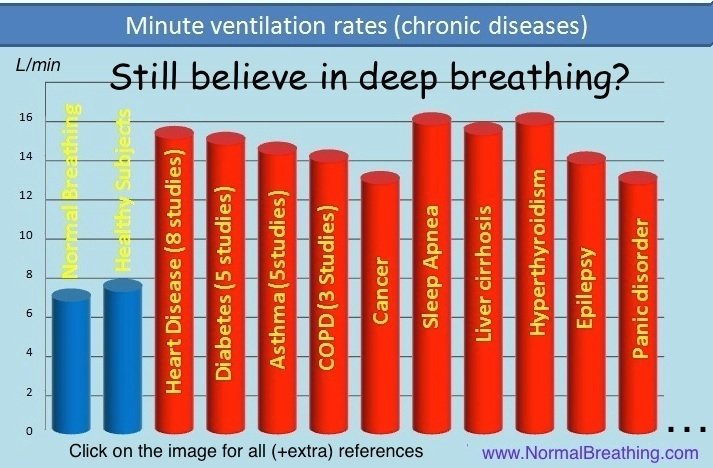
 Therefore, proper breathing techniques should also have answers to the following questions:
- What is the ideal breathing (or unconscious breathing) pattern for maximum body-oxygen content? Note that it is not enough to only think about the maximum oxygen content in the lungs or arterial blood. Oxygen is required in all body cells.
- Which respiratory exercises improve or increase oxygen content in cells?
- What are the common breathing patterns and what are their effects on body-oxygen content?
- What is the exact direction of the respiratory exercises?
- What are the effects of lifestyle factors?
Some features of proper respiratory techniques
| Traditional Hatha yoga | Pursed lip breathing | Strelnikova paradoxical breathing gymnastic | Buteyko breathing method | Frolov breathing device | RESPeRATE guided- breathing device | |
| Diaphragmatic breathing during breathwork |  |
|
|
|
|
|
| Lifestyle factors addressed | |
 |
|
|
* |
|
| Learnt without an instructor | |
|
|
|
|
|
| Constant breath control | |
|
|
|
|
|
| Strict criteria of progress/ success | |
|
|
|
|
|
* Out of several hundred Russian Frolov MDs, only a small group of these medical professionals consider the effects of lifestyle on breathing retraining.
Since I have taught breathing retraining to hundreds of my students, I can provide you, right below here (in the next paragraph), the name of the optimum breathing technique that produces the fastest and easiest results. It is your bonus content.
You need to apply the DIY Breathing Techniques or the Frolov device with Buteyko lifestyle factors that are outlined (as separate Modules) on this website.
[/sociallocker]
 The understanding of Breathing Techniques comes from the knowledge of breathing parameters in both sick and healthy people as well as the effects of breathing patterns on our cells’ oxygen levels (see links to medical studies below).
Breathing Techniques can only improve one’s health if they make one’s breathing pattern, after the breathing session, lighter and slower in terms of minute ventilation. In this case, the student also increases their body oxygen content, which is measured with the simple body-oxygen test. Hence, the personal goal is to achieve a slow and shallow (but diaphragmatic) unconscious breathing pattern, which in turn manifests in better results for the body O2 test. In the long run, better morning results (for this test) reflect the efficiency of a proper breathing retraining technique.
How to choose breathing techniques
This video suggests testing breathing techniques by using a simple morning body-O2 test: Breath Techniques
In relation to healthy lifestyle factors, the Buteyko Breathing Techniques is the most advanced breath technique, only Hatha Yoga comes close. In relation to breathing exercises, the Buteyko method produces good results.
However, most students achieve faster CP progress when using breathing devices, e.g., the Frolov breathing device or the DIY Breathing Techniques. While there are now hundreds of MDs in Russia who promote or endorse the Frolov device, very few of them understand and explain to their patients the importance of having correct lifestyle factors.
Important note. The optimum Breathing Techniques program for a typical student with a chronic disease (and thus, with less than 20 s for the body-oxygen test) includes breathwork with a breathing device (that traps a part of exhaled air) and adherence to Buteyko lifestyle factors.
| Yoga Benefits: How to get the best benefits from this amazing ancient practice? Traditional yoga has been teaching us to breathe less, while modern yoga leaders confuse the public about correct breathing, ideal breathing, and the effects of CO2. | The Pursed lip breathing web page provides an overview of this breath method, the health conditions it addresses (mostly COPD, but many others too), detailed instructions on how to use it, its physiology, and effects. |
| Breathslim is a breathing device that is featured on the Breathslim website. The Breathslim device is an exact copy of the Frolov breathing device developed by Vladimir Frolov. Can it help with weight loss? | The Samozdrav breathing device is another patented Russian invention based on Dr. Buteyko’s discoveries and CO2 effects. Its creators also worked for Soviet Cosmos (Outer Space Research), and they suggested 4 levels of learning… |
| Resperate is an FDA-approved portable device for slow-paced breathing sessions. It had 10 clinical trials on patients with hypertension and could lead to a moderate reduction in blood pressure … | Inspiratory Muscle Training (also known as IMT) can be done using various respiratory trainers or breathing devices, such as Powerbreathe, Expand-A-Lung, PowerLung, and Ultrabreathe. They are all presented below. |
| Powerbreathe is a breathing device used, as the authors and creators claim, to train inspiratory muscles only. It is mostly used for sports performance, but there are medical applications as well. | Expand-A-Lung breathing resistance exerciser is a more recent breathing trainer used to strengthen respiratory muscles due to resistance, which can be regulated.
|
| PowerLung is a device that creates resistance during both inhalations and exhalations. PowerLung has some popularity, especially among athletes… | Ultrabreathe: Review of Ultrabreathe Breathing Device suggests that, as with other Western devices, there is one missing factor in training and analysis of effects. |
| Training Mask is currently the most effective device for physical exercise. This is the only breathing device that can be used during physical activity. It increases CO2 levels in the lungs, increases body O2, VO2 max, endurance, … | Is etCO2 (end-tidal CO2) or capnography useful for breathing retraining? Can capnometers improve the effectiveness of breathing exercises or could it worsen the outcomes? Capnography and etCO2 web page… |
 Warning. Breathing Techniques can cause powerful cleansing reactions and can be dangerous for pregnant women, people with organ transplants, GI problems, and panic attacks, as well as those who take medication for diabetes, hypertension, hypothyroidism, and other conditions. Consult your health care provider and follow special guidelines, which can be found in the Module Restrictions, limits, and temporary contraindications.
Below are authentic comments, questions, and testimonials from the same page on the old PHP site before we converted it to WordPress.
On 2019-07-25T06:31:24, Dr. Artour (mod) wrote:
In certain students, the placebo effect leads to easier breathing and higher CP because of their education: they know in which direction to go as a result of breathing exercises and general breathing awareness 24/7.
The Wim-Hof method can have some additional physiological mechanisms related to hormonal and immune changes.
On 2019-07-24T12:04:08, Dan wrote:
Yes, it was around 5 to 10 sometimes 20 minutes. Thank you for giving me a better method to improve with. If I understood you correctly, even if I improved with my breath holds (not a placebo), that doesn’t mean I would improve the CP? (Could be a placebo). also if that is correct and you cannot improve the cp this way (the practice I’ve mentioned), I would like to hear the science behind this and why the method you’ve mentioned would actually improve the CP. Thank you!
On 2019-07-24T08:25:31, Dr. Artour (mod) wrote:
The total breathing practice here is about 5-10 min per day. You possibly got a placebo effect. Try the Wim-Hof protocol with 40 very large breaths, large inhalation, submerging into very cold water, and then breath-holding for as long as possible. There were many of our students who got very large improvements after 2-3 weeks of using this method. Do it 2-3 times every day.
On 2019-07-24T04:44:02, Dan wrote:
Thank you for your answer.
And sorry about that, the practice was:
Breath normally for 5 minutes then exhale all/most all of the air in a relaxed state (I didn’t really reach to literally 0% of total air just so it’d feel like a normal exhalation and not a forced one). Then I started the timer and was measuring how much I could hold my breath with empty lungs (as long as i can), which means that when you feel like you can’t hold your breath anymore you would feel the stress and I guess the pulse should go higher a bit because of that. So I did it in the morning and before going to sleep (twice a day). after around 2 weeks I measured again the normal cp and the morning cp, they both were a higher morning cp was around 15 before I was doing the practice and it improved to around 23 and the cp that I measured in the evening was always higher(20 before the practice and even 30 after the practice). So again my idea in this experiment/practice was that if I would push my self a little bit every day, maybe I will have a higher score and I could hold my breath for a longer period of time by getting used to the co2(I guess) and achieve a higher co2 tolerance. So yeah I could hold my breath (as long as I could) before the practice for around 25 seconds, and after the practice, I could tolerate around 45 seconds(on empty lungs). Keep in mind that the cp measurements, I think,I did correctly. After 5 minutes of normal breathing from the nose, I exhaled the air, started the timer and when I felt the first desire to breathe I stopped the timer(the pattern of breathing didn’t change, nor the pulse, before and after the cp test and it wasn’t stressful). I’ll be glad to hear your thoughts about this practice Dr. Artour and if I’m wrong about all of this… It seems like it’s possible to get used to the co2 that way (and have a higher cp) for me. What do you think?
On 2019-07-22T06:33:11, Dr. Artour (mod) wrote:
If the morning or usual CP numbers changed, yes, this means that the automatic pattern also changed.
As about the effectiveness of this particular practice in general or for most people, you did not provide all details of your practice. How many times per day you did it? Until which air hunger level? What were the changes in the pulse?
On 2019-07-21T15:04:04, Dan wrote:
Hi, Dr. Artour.
I tried to practice something just to test if it would affect my CP.
What I did was exhaling in a relaxed way all the air, then measured how much seconds I could hold my breath without air in the lungs. I think somebody said that’s called the max cp test not sure, anyways I did that for like 2 weeks (I chose to test this exercise because it’s kinda simple and fast). my goal was to test if I could increase my holding breath time after exhalation and thus increase the normal cp time and I guess that worked (got from 15/17 cp to 23/26 cp) so my question is, theoretically, if someone will do that exact exercise (and only that) and increase his cp successfully, what about his automatic breathing pattern would it change automatically because he increased his cp time?. Btw thanks for the information, I still don’t get why this information is not that well known to the public… Never heard about this until I’ve seen your videos.
On 2019-06-09T05:44:22, Dr. Artour (mod) wrote:
Hello, Amy. Win Hof Review www.normalbreathing.com/wim-hof-review.php; Our method www.normalbreathing.com/learn.php
On 2019-06-08T21:58:02, Amy wrote:
Hi there. Where on your web site are the actual breathing exercises? thanks!
On 2019-06-08T21:09:34, Amy wrote:
Hi Dr. Artour.
Have you discovered Wim Hof the iceman and his breathing technique? let me know what you think!
thanks.
On 2018-09-21T14:24:07, Dr. Artour (mod) wrote:
First, this question specifically relates to the Frolov device while there are many pages that are devoted not to breathing techniques in general but to the Frolov device.
Second, my book includes Dinamika instructions and comparisons, while it is best to ask Dinamika about this innovation in their Czech manual. In addition, it is also individual how people progress and which methods to use. Our students increase air hunger levels, dead volume, and modify their devices making inhalations longer too.
On 2018-08-09T06:38:50, Dr. Artour (mod) wrote:
See online courses and classes https://www.normalbreathing.com/aaa-courses-fees.php
On 2018-08-08T18:46:57, Ramesh Bonigi wrote:
Hi Artour,
Wonderful work from you. May I know how I can reach you in email or call for one of the breathing pattern issues which I am having?
Need my CP increase as well. Please help.
On 2018-06-19T05:26:18, Dr. Artour (mod) wrote:
If you do not react to poor air quality, then it is not an issue for you and your asthma treatment.
On 2018-06-18T18:38:21, Chetna wrote:
Plus avoiding bad air throughout the year isn’t really possible here in India but i am hopeful that working hard will bring in results.
On 2018-06-18T18:36:02, Chetna wrote:
As far as I know, I don’t feel pollution has ever triggered. I am majorly allergic to pollens and citrus foods because I never had asthma during bad air quality days.
On 2018-06-15T07:53:24, Dr. Artour (mod) wrote:
I do not know all your specifics, but our asthma treatment program requires avoiding triggers of asthma.
On 2018-06-14T05:00:49, Chet wrote:
Hello sir,
Sir, i am from India, and, as you can see in the image here, aqi remains really high all the time like 400-1000. So can I still cure my asthma by Buteyko techniques in this bad air even?
On 2018-06-07T04:39:28, Dr. Artour (mod) wrote:
I do not know specifics of your digestion/lifestyle and details of your breathing retraining program. Hence, I cannot predict the parameters you are interested in.
On 2018-06-06T16:02:38, DAVE wrote:
Your site talks about doing breathing exercises on an empty stomach. Does this mean I should wait 2-3 hours after eating or should I wait longer? Also, my CP is around 15. If I do 1 hour of breathing exercises a day could I realistically expect to see improvement?
On 2018-05-19T06:31:26, Dr. Artour (mod) wrote:
Yes, the heart rate also drops.
Average pulse numbers are here https://www.normalbreathing.com/index-buteyko-table-of-health-zones.php
On 2018-05-18T17:50:03, Chetna wrote:
My pulse is between 90-110 all the time. I barely exercise because of asthma and a high pulse is also an outcome of salbutamol. Will Buteyko breathing technique help me reduce my pulse also along with curing asthma.
On 2018-04-10T10:59:16, Anonymous wrote:
I have done a peak flow meter test and that was normal. I have started breathing through my diaphragm 24/7 after years of chest breathing. When I go for walks whilst breathing through my diaphragm I can get aches and pains around my ribs. My CP is around 20.
On 2018-04-09T13:26:21, Dr. Artour (mod) wrote:
It sounds like serious COPD to me, but in any case, it is hard to say what can be done without knowing lifestyle and many other details. The answer can be in sleep, diet, posture, etc.
On 2018-04-08T13:08:17, Anonymous wrote:
I am only doing the exhales with the Frolov, so I need to strengthen my exhale muscles.
On 2018-04-08T12:55:43, Anonymous wrote:
The issue I am having is weak respiratory muscles. When I started I could raise my cp by 8 after 2 minutes. However, I no longer get the cp increase with two minutes. When I increase the time to 4 or 5 minutes I get shortness of breath and cannot maintain the same breathing cycle. I get no heat, and my cp drops. The diaphragm exercise with books is helping but I am wondering if any device would work better to strengthen my diaphragm on exhales. Thanks
On 2018-04-08T12:42:07, Dr. Artour (mod) wrote:
The DIY breathing device can be made easier than Frolov. No info about the relaxator.
On 2018-04-07T19:11:42, Anonymous wrote:
And have you tried the relaxator? https://www.consciousbreathing.com/product/relaxator/
Thanks
On 2018-04-07T19:01:07, Anonymous wrote:
I find the Frolov too strong, even with a very easy setup. I am strengthening my diaphragm with books and that is helping. I am wondering if you recommend another breathing device on this page to help strengthen the diaphragm and provide light air hunger? Thanks
On 2018-03-25T11:53:03, Dr. Artour (mod) wrote:
The correct page for such comments is here:
https://www.normalbreathing.com/more-russian-buteyko-patents.php
Past patents only in Russia/USSR.
On 2018-03-24T22:55:42, DreadedDave wrote:
Just seen here that Buteyko is patented. That is the most ridiculous thing I have ever heard. How can something that is detailed in ancient Yoga texts be patented?
You cannot patent the CP method as many of us have been using that in clinical practice well before it was patented. Forget it, there cannot be any valid patents. All it shows is that those who passed the patent knew nothing about Yoga or how it has been known for years that how long you could hold your breath for after both inhalation and exhalation was a reflection on PH levels and Oxygen levels. It is obvious of course and easy to check which one does what and although the PH can affect the Oxygen levels they can be different. I learned in school in football training that holding my breath was a measure if fitness, of how good my Oxygen was.
Sorry, but you do not have any enforceable patents so please change the website accordingly. If I could find an email address for Artour I would explain in more detail.
On 2018-01-05T07:58:05, Dr. Artour (mod) wrote:
Probably Initial Assessment would be enough.
The same page https://www.normalbreathing.com/aaa-courses-fees.php provides details about how to apply and to which email to send.
On 2018-01-03T08:04:56, Young wrote:
I see. Thank you for responding. Here is a little about me. My CP is around 10 give or take. Yet, I am not overtly sick. I am pretty fit, I do martial arts and I eat well enough. Although, I sleep poorly (the taped mouth helps very much) because I grind my teeth. I also have little ticks that are associated with my breathing. I also get injured easily. Especially in my joints (knees). Mostly, I am interested in the mental/emotional benefits of increased CP. My mind races constantly; it hinders my general life quality. Given my lack of CO2 sensitivity, how long do you think my Skype session will take? Also, is there an email address I can send you more information?
On 2018-01-02T08:49:20, Dr. Artour (mod) wrote:
I travel when invited as the same page explains.
How long with you? It depends on your health state, how far you want to go in your health improvement (or how important your health is), and how much you can learn DIY (very few do).
On 2018-01-02T08:03:58, Young wrote:
Thank you for your response! I live in the Los Angeles, CA area. Will you be in the area soon? Also, I see a lot of prices for Skype on the link you posted. How long would I need to skype with you for to figure out my problem?
On 2018-01-01T09:15:30, Dr. Artour (mod) wrote:
If pulse usually goes up after Buteyko with no caffeine/chocolate during the last 6 hours, your cardiovascular does not respond well to such breathing sessions. It is a complex topic with many variables that require a personal plan. I can teach on Skype https://www.normalbreathing.com/aaa-courses-fees.php or let me know your location – maybe I will be traveling there.
On 2017-12-31T20:44:23, Young wrote:
Hi Artour,
I have practiced the Buteyko Method, as well as with your DIY device. My heart rate goes up and I get headaches, but my CP would increase slowly and I would feel the heat in my body ( in my back). I read in your book that this is a lack of CO2 sensitivity issue, so I do cold showers and bought an earthing pad for sleeping. These made no difference. I would very much like to do this method because I think it would help my ADHD. I am willing to go the distance, I just need to know I am not wasting my time with a lack of CO2 sensitivity. Any help would be greatly appreciated. What should I do?
On 2017-12-11T06:43:54, Dr. Artour (mod) wrote:
Our students who follow the course will likely to improve but very slowly.
Those who follow DIY methods are likely to ignore important things and will get stuck.
On 2017-12-10T18:37:18, DAN wrote:
If I practiced breathing exercises for 30 min every day for several months would I see any long-term benefits or would I have to practice multiple hours every day to see any recognizable benefit?
On 2017-09-13T08:41:20, Dr. Artour (mod) wrote:
> Would you tell me if breathing exercises are for me?
I believe that having normal breathing is essential and even crucial for the good or normal health of each person.
On 2017-09-12T08:05:15, John wrote:
No, but if I paid for a course or attended a workshop of yours..Would you tell me if breathing exercises are for me? Thanks by the way
On 2017-09-11T05:43:23, Dr. Artour (mod) wrote:
I am not your GP and work online.
On 2017-09-10T23:14:25, John wrote:
If I pay for private sessions with you, then can I consult you as my GP?
On 2017-09-10T06:24:21, Dr. Artour (mod) wrote:
Consult your GP for safety questions.
On 2017-09-09T09:13:43, John wrote:
Can breathing retraining be done with high calcium in blood? (GP said to not worry, that it might be due to the salts of Lansoprazole that were taking in the treatment of H. Pylori).
On 2017-09-01T10:44:40, Dr. Artour (mod) wrote:
Hard to say due to too limited experience, but likely it is possible to combine these two at the start and reduce cannabis later…
On 2017-08-31T19:46:00, Jack wrote:
Do you think that Medicinal Cannabis can be used in conjunction with breathing exercises? I have a friend who is a medical cannabis patient and uses it for multiple different conditions. I would like to introduce him to the Buteyko method, but I am unsure if he can safely continue using cannabis while doing things like breathing exercises and mouth taping at night. I fully believe at some point the Buteyko Method will take his health to a place where he no longer needs cannabis, but I am just wondering if it safe, and possible to have success combining the two.
Thank you.
On 2017-06-18T15:31:59, Dr. Artour (mod) wrote:
Usually, breathing students do not use any devices when doing reduced breathing. If one has serious problems with chest breathing, you can continue to use a belt or something else, but this indicates that your morning CP is not growing…
On 2017-06-17T22:52:32, John wrote:
Artour do you recommend anything other than a belt when doing reduced breathing like lumbar support that is available on the likes of amazon.com for example. As wearing a belt can become uncomfortable when it begins to rub on your skin.
Thank you
On 2017-04-15T07:30:13, Artour (mod) wrote:
Intermediate pauses that are done during or in the process of RB are nearly always lower than the first number. This is because of air hunger.
On 2017-04-14T10:44:39, Jack Hepburn wrote:
They do not, but most other practitioners and actually one practitioner trained by you said it to me, so I got confused. I shall assume they are mistake at that MP/EPs happen immediately after RB?
I think a point of confusion was that when MPs follow RB, they are much lower than if they follow an interval?
Jack
On 2017-04-14T07:48:42, Artour (mod) wrote:
> should you then do normal breathing for an interval, before the next maximum pause.
Do any of my books or other sources (on this site and on our YouTube Channel) say about some “interval”?
On 2017-04-13T11:39:58, Jack Hepburn wrote:
Dear Artour, I have 4 of your books but am not 100% clear on this point.
When doing maximum pauses and reduced breathing. you state max pause -> reduced breathing 3-5min -> max pause. My question is: After the reduced breathing, should you then do normal breathing for an interval, before the next maximum pause? Or simply do the max pause straight after the reduced breathing?
Jack
On 2017-01-28T13:34:19, Artour (mod) wrote:
It will help due to immune normalization and cell repair.
On 2017-01-28T08:25:22, Brad wrote:
I have painful neuropathy and I’m only 43, with no other health conditions. All blood/urine work is fine with no viral/bacterial and deficiency problems. No diabetes and no thyroid issues. Can normal breathing help? If yes, how?
Thanks
On 2016-12-05T05:23:00, Artour (mod) wrote:
It is the method of hardening or conditioning to cold. Buteyko liked the idea and used it. Very useful.
On 2016-12-03T22:25:45, HORUS wrote:
Hey, what’s your take on the WIM HOF METHOD? I am very curious about what you think of it or if you would advocate it, thanks.
On 2016-11-08T04:52:51, Artour (mod) wrote:
Ask your MD or GP.
On 2016-11-07T21:14:03, Peter wrote:
I am having problems with a hiatus hernia. Is it safe to exercise, run, fast walk, and cycle breathing with belly and diaphragm?
On 2016-11-04T08:57:55, Artour (mod) wrote:
To ak.bharath.rajan
Go to http://www.normalbreathing.com/learn.php
To Joe:
2 hours of daily breathwork would be already great, but if you want 4, yes, you can practice as you described.
On 2016-11-04T04:20:49, Joe wrote:
In your books, you suggest up to 4 hrs daily of breathing exercises on an empty stomach. For example 30 min sessions with a 2 hr. break in between.
So, if I do a 30 min session every two hours on an empty stomach.(6am, 8am, 10am, 12pm, 2pm, 4pm, 6pm and 8pm) then when do I eat? Should I just eat light meals in between or will this diminish the effects of the training?
On 2016-11-03T10:24:32, ak.bharath.rajan wrote:
Hi There,
I have chrons disease(IBD). I had surgery removed a small part of the small intestine due to bowel perforation. I taking tablets for depression for nearly 20 years. Could please tell me in simple steps of the Buteyko breathing technique. Is it like 5 seconds inhale, 5 seconds hold, exhale completely and hold and avoid air inhalation for 5 seconds? is it good to increase pause gradually after exhalation. Apart from that How to get sound sleep at night. Please help me. Give me in simple steps.
Kindest regards,
Bharath AK
On 2016-11-02T04:39:36, Artour (mod) wrote:
My Skype online and live students provide me with over 70 details related to their lifestyle and health state. Then I can see what can be changed or missing in their current work to move forward. Success.
On 2016-10-31T19:58:22, Thom wrote:
Hi, Artour I’ve been using the Frolov device and modules for 5 months today after discovering Buteyko, I’ve been suffering from pretty severe CFS/anxiety since the start of the year. I am almost 18, 5’10 in height, and have dropped from 9.5 stone to 8 is this normal, and is it safe for me to continue using reduced breathing, also my cp is still pretty low, any tips? Thank you for ur time and this amazing website, u and Buteyko have truly helped better my quality of life.
On 2016-09-25T10:15:10, Artour (mod) wrote:
Nor normal or not common, but should go away with higher CPs.
On 2016-09-25T00:17:23, Joe wrote:
I have been doing one hour of breathing exercises for a couple of weeks. I noticed a slight positive change in heart rate and CP. However, despite trying to relax, my vocal cords get very tense and even causes my voice to crack sometimes. Is this normal? Is this something that will go away as CP goes up?
On 2016-08-29T07:23:32, Artour (mod) wrote:
Yes. This page has more details http://www.normalbreathing.com/CO2-stabilizer.php
On 2016-08-28T21:19:02, Jake wrote:
Hey Artour,
I stumbled across this breathing method today and have tried the basic exercises. I noticed thereafter that while my energy significantly increased, I was much more aggressive and “mean”. As I practice this technique daily, will my emotions “neutralize”?
Jake
On 2016-07-19T06:14:36, Artour (mod) wrote:
It depends on the session and body states, up to 3-7 s.
On 2016-07-18T21:01:48, Joe wrote:
What’s the most you can increase your cp in 1 session?
Great website Thanks!
On 2016-07-06T05:07:41, Artour (mod) wrote:
http://www.normalbreathing.com/learn.php#Module_9._Restrictions_limits_and_temporary_contraindications
On 2016-07-05T16:53:33, George wrote:
Artour what would you say is the best technique using the Frolov device for a fast cp rise?
All the best.
On 2016-06-16T02:16:32, Artour (mod) wrote:
Ben: You can increase your CP.
EF: It varies a lot depending on their health state. Progression rates are also individual and can be widely different.
On 2016-06-15T11:36:39, EF wrote:
Hi artour at what cp will I be able to walk without being breathless and also it has taken me a month to get to 5 and below cp’s what are your thoughts on this and my progression?
On 2016-05-22T07:54:21, Ben wrote:
Hi, I am a cyclist who competes at the National level in Australia, I have been practicing the Buteyko method for 2 years and have a cp over 45’s, the only problem is I race cyclocross which is just for 1hr and is an all-out effort. Within 5 mins of racing my nose blocks up and I am forced to breathe through my mouth, I normally can train very hard with nose breathing, but racing is putting yourself on the limit and I always get my air restricted. Is there anything I can do about this?
On 2016-05-07T09:22:16, Artour (mod) wrote:
Yes, if lifestyle violates evolutionary designs or norms, people breathe more.
On 2016-05-06T11:12:16, john wrote:
Thanks for answering,
I’m concerned with the initial study though, we all know you can fit a narrative to a false premise(even one you really believe in). Just brush aside what supports your product/ideas and keep what you like.
I agree that in rest an easy and calm breath pattern is present in healthy individuals. But if you don’t have that (presuming no mental issues, very serious illness) there are probably other things you need to work on. your lung capacity, your cardiovascular system. if those things are efficient (by working out, bike rides, walking/running, quit bad habits) you need less breath to be sufficient. Do you agree?
On 2016-05-06T10:09:05, Artour (mod) wrote:
Results of over 100 studies are on the Homepage. Studies, including numerous trials, and experiences of thousands of people show that reducing ventilation reverses symptoms and degree of diseases.
Oxygen pathway is controlled by CO2 – this is the basic law of respirology.
On 2016-05-06T00:47:17, john wrote:
Seems a bit backward to me. so that Russian doctors did studies on healthy and sick people and concluded the sick breath more heavy therefore heavy breathing is the cause of their particular illness. that’s weird right? more logical would be that because you’re sick/unhealthy that whole oxygen pathway just works less efficient so you need to do more of it.
On 2016-03-20T11:35:05, Artour (mod) wrote:
For evidence, see your MD or GP to whom you pay taxes and whose studies, over 97%, are about drugs, not things of real life, such as exercise, sleep, diet, breathing…
On 2016-03-19T18:18:10, Tobias wrote:
Hello Artour,
can you please provide some evidence of CP being a direct measurement of tissue oxygenation?
I agree that CPs < 15s are probably very indicative of health problems. but i think it is possible to have a cp of ~30 and be in very good health.
a person with good thyroid function and a high metabolic rate will have to breath more volume even though he has adequate levels of CO2.
>
On 2016-01-23T09:59:48, Ian wrote:
Thank you very much for the reply I will look at the courses straight away
On 2016-01-23T06:07:46, Artour (mod) wrote:
Hello, Ian,
Many people do not get warmer hands after sessions or in 1-2 min after starting them at the beginning. With higher CPs, these effects are more likely.
For Skype and online courses, you can visit www.normalbreathing.com/aaa-courses-fees.php
On 2016-01-22T13:11:45, Ian wrote:
Dear Dr. Artour. I am using the Frolov device and I have read your books on the device and “Advanced Buteyko Exercises” book. My question is that when I use the device my hands do not get warm very often. My pulse drops on average 3-4 beats per minute, however. I struggle to measure CP as I can often underestimate or overestimate my CP. If my pulse is dropping after the breathing session but my hands are still cold, does that mean the session was ineffective?? Also, it is possible to have some kind of one-to-one lessons with you on Skype, etc? I live in the UK and really want to cure my Asthma and be as healthy as possible. I am very committed as long as I know I am performing breathing exercises etc correctly.
Thank you in advance
On 2015-12-19T15:54:09, Binoy Gupta wrote:
I am having constant belching which causes pain in the vocal cords.
I have severe belching while going to sleep. But once I am asleep, there is no belching. Belching is also greatly reduced when I am busy.
On 2015-12-14T06:54:14, Artour (mod) wrote:
Hard to tell what is a good way to move forward with health without any extra details, like the CP, MCP, presence of chest breathing, ability to exercise, sleep parameters, and various other lifestyle parameters.
On 2015-12-13T20:02:41, mike wrote:
And to extrapolate – the CO2 level is at the high end of the normal range from this clinic, and outside the range of other places I have seen, so I’ve been wondering if I should be trying to decrease this level.
On 2015-12-13T20:01:32, mike wrote:
All of these devices seem to try to increase CO2. I have blood oxygen typically of 99%, and the CO2 in my blood is 31 mmol/L. I find myself having weak exhalations, and at times have trouble breathing. I have been diagnosed with asthma with an air output of about 66% of what the doctor expected. Is there a device or exercise that would be appropriate for these conditions?
On 2015-12-02T05:34:14, Artour (mod) wrote:
No, only for exercise.
On 2015-12-01T16:03:26, Nick wrote:
Would you recommend the use of a training mask without physical effort? If yes, how long is appropriate?
On 2015-10-24T06:58:19, Matias wrote:
Some people have asked about Wim Hof on various pages on this website. Here’s a relevant study:
http://www.pnas.org/content/111/20/7379.full
Here are three snippets from the study just to get the idea:
“Healthy volunteers were randomized to either the intervention (n = 12) or control group (n = 12).”
“The trained group was trained by Dutch individual Wim Hof and three trainers who previously received an instructor course by Wim Hof to become a trainer.”
“Healthy volunteers practicing the learned techniques exhibited profound increases in the release of epinephrine, which in turn led to increased production of anti-inflammatory mediators and subsequent dampening of the proinflammatory cytokine response elicited by intravenous administration of bacterial endotoxin.”
***
Here’s a documentary about Wim Hof:
I’ve not watched it yet myself. But after a quick glance, some of the breathing techniques look really ridiculous. E.g. at 4:15-4:30 in the video.
On 2015-09-30T07:45:43, Artour (mod) wrote:
The effects depend on what and how you try, as well as your personal parameters. There are many pages on this site that explain restrictions, contraindications, overtraining, a loss of CO2 sensitivity, and many other effects.
On 2015-09-30T04:28:41, Anonymous wrote:
When I try this Buteyko technique, my head became dizzy and my body becomes powerless. Am I short of o2?
On 2015-09-08T15:14:58, Artour (mod) wrote:
Thanks. Sorry, I do not explain feelings in relation to breath. It is hard to tell what exactly you do when you “breathe only with my lower stomach all the time” until you start measuring its effects on breathing retraining.
On 2015-09-08T12:41:47, Anony wrote:
I find the information here interesting, however, I do have a question to ask.
Yogis from the past said that the less one breathes, the longer he lives. They also said that one should breathe with a full capacity of the lungs, but very slowly. First fill the stomach, then the rib cage, finally the chest. Full breath, but very slowly. I, for example, can easily do away with 2 regular full breaths for a minute, usually even less, and while doing other things. If I breathe only with my lower stomach all the time, I do not feel natural. Can you explain this?
On 2015-09-07T17:20:27, Artour (mod) wrote:
I do not see the reasons to decrease CO2 there. All these methods that are provided on this site are about getting more CO2 in the lungs and cells.
On 2015-09-07T12:47:53, Lee wrote:
http://fellrnr.com/wiki/DIY_Altitude_Training
What do you think of this method? Low o2 and low co2. In my understanding, it might have some benefits with increasing EPO and mental capacity, but having low o2 and low co2 makes no sense, right? You would end up with blood hypoxia, tissue hypoxia, low co2 – relative hyperventilation, alkalosis respiratory, bicarbonate loss at kidneys, etc > effectively true self suffocation
On 2015-08-18T14:14:27, Artour (mod) wrote:
If you read carefully your comment, you can see that you mix (and maybe confuse) feeling during exercises and feeling in general (after exercises too).
Exercises are easy and stress-free when practiced correctly.
Some might feel worse in general when do not take missing nutrients.
On 2015-08-17T20:55:25, Anon wrote:
Hi Artour,
is it normal to feel unwell at the start of Buteyko training? And if yes, for how long? I ask this because in my research online I have come across people who say that the training itself made them feel horrible. They are very pleased with the results and now feel great but they say things like that while doing the exercises you feel unwell, nauseous and one person even said it made them feel depressed! This makes me reluctant to try Buteyko as the thought of being lightheaded and nauseous already makes me anxious. What is your opinion on this?
On 2015-06-16T08:58:55, Artour (mod) wrote:
Lying down would unlikely to help, meditation does.
On 2015-06-16T00:57:39, Danny wrote:
Can the Om of Gong Meditations help improve CP, does one need to do the meditations Sitting cross-legged or can one do them lying down…
Thanks
On 2015-06-14T09:24:48, Artour (mod) wrote:
It may work, measure your morning CP progress, then you know.
On 2015-06-14T08:21:05, Philipp wrote:
Hello Dr. Rakhimov,
I have a question regarding breathing exercises or shall I better say don’t have a special exercise. I just sit down and try to breathe as slowly as possible, I do a pause when totally exhaled and as soon as I feel the diaphragm moving I continue inhaling as slow as possible. I do this for around 15 to 20 minutes and if I understood all the things right I’ve read on your webpage it should increase my CO2 content in the blood. I feel my body heating up and the bowels start to move. The thing is that I don’t like methods that use the counting of seconds. The only thing I measure is CP. Do you think I can have significant long term success using this kind of training as well as changing the unconscious breathing pattern? I was thinking about using a training mask while riding on my bicycle to work which would add to my time spent on breath reduction per day.
By the way, when I practice fasting I have an enormous gain in the CP.
Poka Philipp
On 2015-05-28T11:27:45, Artour Rakhimov (mod) wrote:
Still, too many other factors can interfere. Most people would need a little more effort. And it would be easier with 30+ s morning CP.
On 2015-05-27T15:53:05, Anonymous wrote:
Artour,
I don’t have the time to do short breathing exercise 4 times per day.
Is it also ok to do 30 minutes (15 RB + 15 Frolov) when I wake up, and 30 minutes (15RB + 15 Frolov) before I go to bed?
Will I get good results if I do this with 60-90 minutes of physical exercise every day?
All other factors (sleep, earthing, focal infections, nutrition, etc) are good.
I did not practice Buteyko for a long time, and now I want to try again and get a 40+ CP.
My starting CP right now is 20
On 2015-05-06T06:43:21, Artour Rakhimov (mod) wrote:
Very rarely.
On 2015-05-05T09:55:14, Martin wrote:
Makes sense. But my pulse is already low. Often it is 45-50 and my CP is low as well. Could it be that it would actually be beneficial if my pulse increases?
On 2015-04-26T09:19:05, Artour Rakhimov (mod) wrote:
It can be. Measure your final pulse and CP to see the main effects.
On 2015-04-25T19:09:44, Martin wrote:
Hi. After doing breathing exercises I feel much better and my hands go from cold to warm. But if I continue doing the exercises, i feel a shortness of breath. Could that be due to overtraining?
Thanks!
On 2015-04-21T03:56:39, Artour Rakhimov (mod) wrote:
I see no benefit in this breathing method and no science behind it. Cold exposure is a different story.
On 2015-04-20T12:48:12, Lee wrote:
I agree it makes no sense.
At 4min you can watch a room of people hyperventilating. So the breathing method is to hyperventilate, then to hold your breath, kind of like a CP breath-hold. Of course after lots of hyperventilating, with little co2 the breath-hold is very long.
What would be the benefit of this at all? Or can you see no benefit?
On 2015-04-20T06:44:06, Artour Rakhimov (mod) wrote:
This PDF looks like a piece of confusion: no purpose of the process, no baseline, no goals. Normal blood oxygenation with normal breathing at rest is 98-99%… How can these numbers be doubled?
On 2015-04-19T10:45:13, Anonymous wrote:
http://www.innerfire.nl/files/1504On 2013-wim-hof-method.pdf
If I am not mistaken it seems as though his idea is completely opposite to yours…he seems to promote hyperventilation. Which makes no sense, right?
On 2015-04-19T05:49:58, Artour Rakhimov (mod) wrote:
Cold exposure helps and works well. As for the breathing method, there is no science behind that. It is also not a method of breathing retraining since there is no goal for the WIM HOF breathing method, and no tests to measure the progress.
On 2015-04-18T17:36:51, Lee wrote:
What do you think of the WIM HOF breathing method?
On 2015-04-10T06:41:59, Artour Rakhimov (mod) wrote:
It is a large and long topic with safety rules and many sp[cifics. Details are in the book “Advanced Buteyko Breathing Exercises”.
On 2015-04-09T20:12:26, Anonymous wrote:
Hello Artour,
Can you tell something more about the “click effect”?
How does this boost my CP?
Does it work for everyone?
On 2015-02-16T15:31:27, Artour Rakhimov (mod) wrote:
Thanks for the correction. It should be 32 USD in both places (corrected).
There is only one DIY Device book, and all versions and devices get the most recent edition of this book.
On 2015-02-15T21:33:57, Peja wrote:
I want to buy a PDF PC version of book ‘Amazing DIY breathing device’, but there are two links with two different prices 28$ and 32$. Is there a difference between these books, and which one gives a completely manual for making and using a DIY breathing device?
On 2015-02-13T19:33:01, Miklos wrote:
I think this is not the proper place to chat about it. My e-mail is: gyogyitomiklos@gmail.com
On 2015-02-11T11:38:43, Miklos wrote:
Which part is interesting for you?
On 2015-01-29T09:18:49, Anonymous wrote:
Miklos, can you share more details about your own breathing device? I’m interested in it, sounds good.
On 2015-01-27T21:49:10, Artour Rakhimov (mod) wrote:
Great to hear. Success.
On 2013-11-14T08:30:20, Artour (mod) wrote:
It depends on chewing, stomach’s and GI health, the CP, and other factors.
> Ok. I have been applying your techniques for a year and a half, they have changed my life.
Great to hear. You can leave a short testimonial (even without your full or real name) here: http://www.normalbreathing.com/buteyko-testimonials.php This will help others to follow the path and improve their health.
On 2013-11-14T02:53:32, Matt wrote:
Ok. I have been applying your techniques for a year and a half, they have changed my life. Now I am trying alternative day fasting (take only 20% of usual calories every second day). I noticed breathing techniques much easier on empty stomach. So I wanted to ask a second question: You say practice breathing techniques (reduced breathing) on an empty stomach, to avoid inflammation, but i notice my body still tried to reduce breathing even after a meal. Is it better to try and breathe *more* after a meal?
On 2013-08-04T18:01:51, Artour (mod) wrote:
According to Dr. Buteyko, this idea works.
On 2013-07-30T07:36:05, Artour (mod) wrote:
http://www.normalbreathing.com/how-to-sleep-less.php
On 2013-06-17T15:27:39, Rob wrote:
Are there any other ways to get oxygen into the cells? I heard about something called Oxy drops (I think)….do you know about this product and what is your opinion?
On 2013-06-15T06:11:16, Artour (mod) wrote:
Warm or hot water and gentle inhalations and exhalations.
On 2013-06-15T01:32:28, Deev wrote:
I just did my 2nd DIY device breathing session and now I have a strange feeling in my throat/windpipe. It makes me want to cough but the cough does nothing. It has lasted over 6 hours now. It feels like I have a little bit of water in my throat that I need to clear, but I cannot clear it by coughing like normal. It does not affect my breathing. My first session with the DIY device was good.
On 2013-04-28T21:47:02, TP wrote:
Artour – Are Strelnikova exercises done with nasal breathing only? I have seen different translations of instructions some of which say you should keep your mouth shut whilst others suggest a passive exhalation through the mouth after an active inhalation?….Thanks
On 2013-04-18T13:05:21, Artour (mod) wrote:
The manual says how to proceed with air hunger, from one stage to the next one depending on the symptoms and results.
If you practice with the DIY device for more than 1 hour per day and follow all other ideas, while cannot increase the CP, it is possible that there is something else that prevents your progress (low cortisol, root canals, etc.). Increase the breathwork to 2 hours and see the effects.
On 2013-02-02T20:33:51, Anon wrote:
My present CP fluctuates from 5 to 10. I feel sleepy after every 4 to 5 hours.
I just completed my graduation & will purchase your books after getting a job.
How much CP can I increase if I read & apply all the information available on this website?
On 2012-12-26T23:37:12, Artour (mod) wrote:
Yes, there are restrictions if you use thyroxine or similar supplements or medication. They need to be reduced at higher CPs.
Due to overdose (if you increase your CP), breathing exercises can cause heart palpitations.
On 2012-12-26T13:50:08, Anonymous wrote:
I take medication for my thyroid; half was removed due to a tumor – I see notes in the disclaimer re using breathing techniques for hypothyroidism – would this also be true in my case?
On 2012-12-16T18:47:50, Artour (mod) wrote:
> a disdain for CO2 in the lungs
Then you know about the level of his education in the basics of physiology.
On 2012-12-16T13:20:18, Rich D. wrote:
Hi Artour…my question is this: do you have knowledge of “The Breathing Trainer” system as advertised by a Dr. Dean Hillsman…he offers some interesting material on his site but from a casual reading there still seems to be a disdain for CO2 in the lungs and an emphasis on getting “stale trapped air” out and more “fresh” air in.