- Updated on November 1, 2020
 By Dr. Artour Rakhimov, Alternative Health Educator and Author
- Medically Reviewed by Dr. David Walker, CPA, Licensed Psychologist
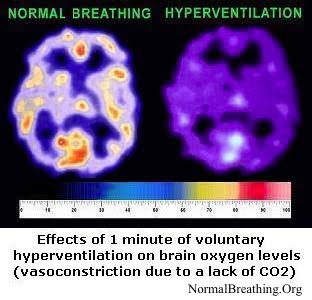 Numerous Western medical studies have discovered that brain diseases (or disorders of the central nervous system – CNS) are possible only in conditions of chronic hyperventilation (the most likely scenario) or chest breathing and mouth breathing. All these respiratory deviations result in decreased levels of oxygen in the brain.
Here is a video from “2020 Fortify Your Brain Summit” in which Dr. Artour explains how breathing and breathing retraining influence the brain and the CNS:
The URL of this video on breathing and brain diseases is https://www.youtube.com/watch?v=rxq92ReduP0 /.
It is beyond doubt that low oxygen levels in brain cells have a profound negative effect on the function of nerve cells of the CNS, as Dr. Buteyko suggested decades ago. Brain hypoxia leads to anaerobic cellular respiration, generation of lactic acid and free radicals, acidic pH cellular environment, chronic inflammation, the inability of the immune system to heal injuries and many other negative effects (see the links to medical research below), that include the possible formation of brain tumors (e.g., glioblastomas), development of plaque in the brain (leading to Alzheimer’s disease) and other brain abnormalities causing dementia and Parkinson’s.
Well over 90% of modern people have abnormally low brain O2 and CO2 levels 24/7 due to chronic overbreathing. Here are historical changes related to a large increase in breathing.
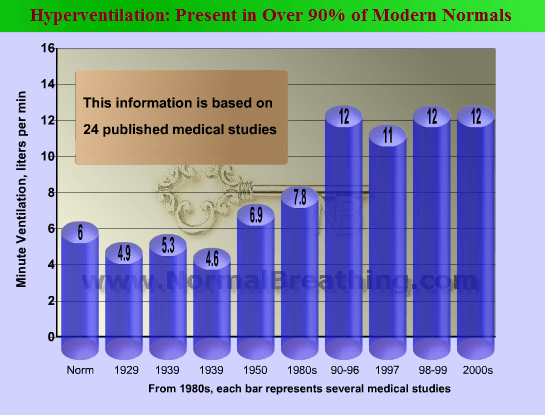
 Furthermore, since most brain diseases are characterized by chronic hyperventilation, there are additional effects due to low CO2 levels in the CNS. For example, hypocapnia is devastating since CO2 is a powerful relaxant or stabilizer of the nerve cells. Hyperventilation leads to “spontaneous and asynchronous firing of neurons”, as we learned in the section devoted to CO2 effects related to the nerve cells.
People with panic attacks, seizures, sleeping problems, anxiety breathing disorders, depression, bipolar disorder, senile dementia, Parkinson, Alzheimer disease, and many other chronic and degenerative health conditions (see this link for other brain disorders) have ineffective, or heavy or irregular breathing patterns often accompanied by habitual thoracic and mouth breathing.
Brain-CNS disorders and minute ventilation studies
| Condition | Minute ventilation |
Number of patients |
All references or click below for abstracts |
| Healthy Subjects | 6-7 l/min | >400 | Results of 14 studies |
| Normal breathing | 6 l/min | – | Medical textbooks |
| Epilepsy | 13 l/min | 12 | Esquivel et al, 1991 |
| Panic disorder | 12 (+-5) l/min | 12 | Pain et al, 1991 |
| Bipolar disorder | 11 (+-) l/min | 16 | MacKinnon et al, 2007 |
 All these and many other studies testify about classical chronic hyperventilation syndrome.
Treat brain cancers (glioblastomas), Parkinson’s, dementia, and Alzheimer’s disease with diet and breath
Here is a video interview by Dr. Artour Rakhimov with Misha Sakharoff. This YouTube video discusses application of the Buteyko breathing method and carnivore ketogenic diet (as well as PKD – paleolithic ketogenic diet) for natural elimination of glioblastomas and reversal of dementia, Parkinson’s and Alzheimer’s disease.
Youtube link: Treat glioblastomas, Alzheimer’s disease, Parkinson’s, and dementia with diet and breath.
Dr. Artour and Misha discuss a highly successful use of the Buteyko breathing technique (breathing retraining) and metabolic approaches to brain diseases such as diets: therapeutic ketogenic diet, PKD (paleolithic ketogenic diet) – the diet developed by Hungarian doctors from Paleomedicina.com led by Dr. Zsofia Clemens. This method works even for Stages 3 and 4 brain cancers.
Research on breathing in people with brain diseases
In 1990, American psychiatrists from Hunter College (City University of New York) reported results from several groups of subjects with anxiety, panic phobia, depression, migraine, and idiopathic seizures. The abstract states “virtually all the non-control subjects were found to show moderate to severe hyperventilation and accompanying EEG dysrhythmia”. In addition, it notes that hyperventilation and abnormal electrical signals in the brain took place simultaneously.
The parameters in the sick are usually much worse during early morning hours due to sleep heavy breathing effects (often caused by mouth breathing and supine sleep), after meals, during and after exercise with mouth breathing, during and after stress, and in many other situations.
Diseases of the CNS and brain disorders and CO2 levels
 In 1976 the British Journal of Psychiatry published a study of CO2 measurements in 60 patients with neurotic depression and non-retarded endogenous depression (Mora et al, 1976). All patients had abnormally low carbon dioxide values.
Canadian scientists from the Department of Psychiatry (University of Manitoba, Winnipeg) measured carbon dioxide concentrations in over 20 patients with panic disorder. Their average CO2 was also below the medical norm (Stein & Asmundson, 1994). There are many other studies that report abnormally low CO2 values for people with various psychological and neurological problems.
Chest and mouth breathing as causes of diseases of the brain and disorders
 While these Western studies suggest the possible role of over breathing in the appearance and development of various neurological and psychological diseases, it is also known that low oxygen levels in the brain and body tissues can occur due to the habitual chest and/or mouth breathing. Chest breathing results in drastic reduction of blood oxygenation since lower parts of the lungs get 6-7 times richer blood supply, while adverse biochemical and immune effects of mouth breathing are too numerous to mention here (see Mouth Breathing web page for details).
Successful treatment of brain/CNS diseases with Buteyko Method
At the same time, there is no any evidence showing that people with normal breathing parameters can suffer from neurological or psychological problems. Furthermore, clinical experience of more than 170 Russian and Soviet Buteyko MDs practicing the Buteyko breathing technique indicates that people with brain diseases and CNS disorders always have less than 30 s for the body-oxygen test. Therefore, breathing normalization with Buteyko lifetsyle should always be a key element (if not the key element) in the treatment of brain diseases.
Medical References
Fried R, Fox MC, Carlton RM., Effect of diaphragmatic respiration with end-tidal CO2 biofeedback on respiration, EEG, and seizure frequency in idiopathic epilepsy., Ann N Y Acad Sci. 1990;602:67-96.
Stein MB, Asmundson GJ. Autonomic function in panic disorder: cardiorespiratory and plasma catecholamine responsivity to multiple challenges of the autonomic nervous system., Biol Psychiatry. 1994 Oct 15;36(8):548-58.
JD Mora, L Grant, P Kenyon, MK Patel and FA Jenner, Respiratory ventilation and carbon dioxide levels in syndromes of depression, The British Journal of Psychiatry 129: 457-464 (1976)
Sikter A, Faludi G, Rihmer Z., The role of carbon dioxide (and intracellular pH) in the pathomechanism of several mental disorders. Are the diseases of civilization caused by learnt behaviour, not the stress itself?, Europsychopharmacol Hung. 2009 Sep;11(3):161-73