- Updated on August 13, 2020
 By Dr. Artour Rakhimov, Alternative Health Educator and Author
- Medically Reviewed by Naziliya Rakhimova, MD
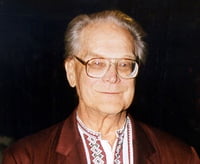 Dr. Buteyko, before inventing the Buteyko method, suggested that sick people have too heavy breathing at rest and this causes low body oxygenation. There are hundreds of Western medical studies that confirmed that overbreathing (or hyperventilation) reduces oxygen delivery to cells (you can find many of these studies on pages of this website), but do people with chronic diseases breathe more than the medical norms? Do healthy people breathe less air?
Consider these results of nearly 100 medical studies. 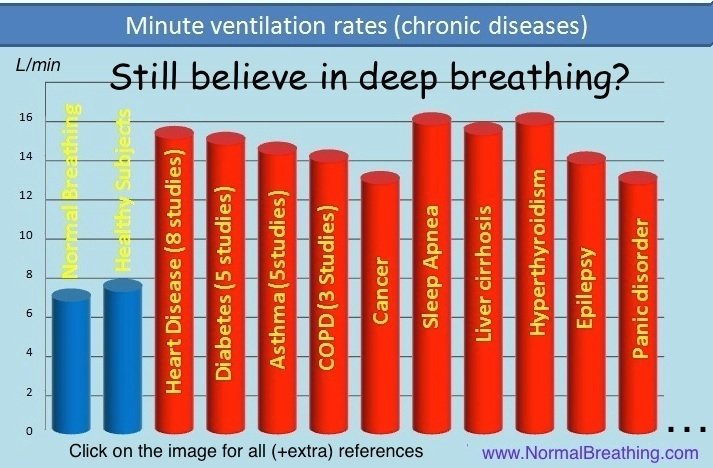
We can see that these sick people breathe about 2-3 times more than the norm. Their breathing is usually faster (about 20-26 breaths per minute instead of 12 breaths/min) and deeper (up to 600-800 ml for tidal volume instead of 500 ml). Furthermore, there are numerous studies quoted on this site that showed that terminally sick people breathe even faster: up to 30-40 breaths per minute for terminal stages of cancer, HIV-AIDS, cystic fibrosis, and other conditions. Dr. Buteyko collected such respiratory information from thousands of sick and healthy people. He applied for a patent that claims that respiratory parameters of people predict their health states. In fact, Soviet and Russian Buteyko doctors generally prescribe medications based on the respiratory parameters of their patients. In order to evaluate the health of their patients, they use the Buteyko Table of Health Zones.
Buteyko Table of Health Zones (average parameters at rest)
| Health state | Type of breathing | Health level | Pulse, beats/min | Breathing frequency/min | CO2 in alveoli, % | AP, s | CP, s | MP, s |
| Super-health | Shallow | 12 | 48 | 3 | 7.5 | 16 | 180 | 210 |
| 11 | 50 | 4 | 7.4 | 12 | 150 | 190 | ||
| 10 | 52 | 5 | 7.3 | 9 | 120 | 170 | ||
| 9 | 55 | 6 | 7.1 | 7 | 100 | 150 | ||
| 8 | 57 | 7 | 6.8 | 5 | 80 | 120 | ||
| Normal | Normal | 7 | 60 | 8 | 6.5 | 4 | 60 | 90 |
| Disease | Deep | 6 | 65 | 10 | 6.0 | 3 | 50 | 75 |
| 5 | 70 | 12 | 5.5 | 2 | 40 | 60 | ||
| 4 | 75 | 15 | 5.0 | – | 30 | 50 | ||
| 3 | 80 | 20 | 4.5 | – | 20 | 40 | ||
| 2 | 90 | 26 | 4.0 | – | 10 | 20 | ||
| 1 | 100 | 30 | 3.5 | – | 5 | 10 |
 Comments on Buteyko Table of Health Zones. Pulse – heart rate or pulse rate in 1 minute; Breathing or Respiratory frequency in one minute (number of inhalations or exhalations); % CO2 – %CO2 in alveoli of the lungs (*or arterial blood if there is no mismatch); AP – the Automatic Pause or natural delay in breathing after exhalation (*during unconscious breathing); CP – the Control Pause (body-oxygen test, breath-holding time after usual exhalation and until first distress only); MP (the Maximum Pause, breath-holding time after usual exhalation and as long as possible).
This discovery is patented (see the bottom of this page) and the Health Table is based on Buteyko KP, The method of volitional elimination of deep breathing [Translation of the Small Buteyko Manual], Voskresensk, 1994. *
Note about pulse. Not all people with low CPs (less than 20 s) have a greatly increased heart rate, as is given by this Table. Some categories of people with less than 20 s CP can have a resting pulse of around 60 – 70 beats per minute and sometimes even much less (often due to years of physical training). However, increased average heart rate numbers for lower CPs are the feature of, for example, heart patients, patients with severe asthma, cancer, and many other conditions. During the 1960s, when conducting his research, and later, Buteyko and his colleagues applied for the Buteyko breathing retraining program mainly on severely sick people for whom high pulse, for 2 lowest zones of health, is very common. Thus, the number of heart rate given above should be viewed as a general statistical observation.
In this YouTube video below, Dr. Artour explains this Buteyko Health Table.
Origins of the Buteyko Health Table
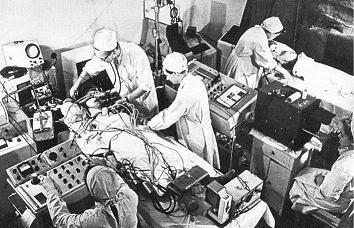 Dr. Buteyko developed this Table during the 1960s after he developed the Buteyko breathing method and analyzed hundreds of sick and healthy people in his respiratory laboratory. He presented this Health Table during his Lecture for the leading scientists at the Moscow State University in 1969. The Table reflects the health of his numerous hospitalized and severely sick patients, who started their journey for health at the very bottom of the Table and climbed up, sometimes to the very top of the Health Table.
Structure and description
June 2019 Innovation. In the video below, Dr. Artour suggested using Buteyko Health Levels (from 1 to 12) in order to describe the health states of breathing students and ordinary people. Health Level 1 corresponds to the first row above “Death” (people with 5 s CP). Then each row above corresponds to a step-wise increase in the Health Level (by one).
Thus, the middle row of the Table corresponds to normal health or Buteyko Health Level 7 (60 s CP). Below this row are 7 zones corresponding to disease. Five zones of super-health are above the middle row (the norm). Let us start from the very bottom of this Table and then climb up.
Terminally sick and critically ill patients during acute stages (below Health Level 1)
The lowest row of this Health Table (below Health Level 1) corresponds to severely sick and terminally ill patients in critical conditions. When people are at the risk of dying, the Table predicts over 100 beats per minute for their heart rate, over 30 breaths per minute for respiratory frequency, less than 3.5% CO2 in the alveoli of the lungs. The CP (Control Pause or stress-free breath holding time after usual exhalation) is less than 5 s.
Terminally sick and critically ill patients in more stable conditions

The next health zone from the bottom (below Health Level 2) corresponds to severely sick and terminally ill patients in stable conditions. Typical heart rates or pulse of such people are above 90 beats per minute (sitting at rest). Respiratory rate (or breathing frequency) is above 26 breaths per minute at rest. A CO2 concentration in the alveoli of the lungs is no more than 4%. There is no automatic pause (period of no breathing after exhalation). The Control Pause is less than 10 s, while the Maximum Pause is less than 20 s. (Numerous medical studies confirmed that over 90% of patients with chronic diseases indeed die in conditions of severe hyperventilation, while their heart rate and respiratory frequency become much higher than the norms. Quotes and exact numbers from such studies can be found on my website in relation to heart disease, asthma, cancer, and many other conditions.)
These patients usually require numerous types of medication to prevent multiple symptoms and complaints. Walking is hard and climbing stairs, due to heavy labored breathing, dyspnea, and low body oxygenation, is often impossible. Most of the time is spent in bed since even sitting requires effort.
Sleep is dreadful since breathing and symptoms get much worse after the transition into a horizontal position. Early morning hours (4-7 am) is the time when these patients are most likely to die from a heart attack, stroke, asthma attack, or complications from cancer, diabetes, and many other pathologies.
Patients with a moderate degree of their disease
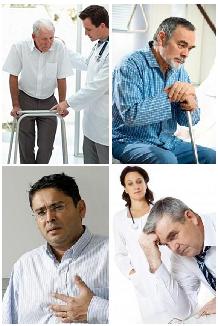 People who are between Buteyko Health Levels 2 and 3 (10-20 s CP) are patients whose life is not threatened at the moment, but their main concerns are dealing with various symptoms. People with mild asthma, heart disease, diabetes, 1 and 2 stages of cancer, and many other chronic disorders are all in this zone. Taking medication is the normal feature for most of these people.
As we see from the Table, pulse or heart rate for these patients varies from 80 to 90 beats per minute. Breathing frequency is between 20 and 26 breaths per minute (the medical norm is 12, while doctor Buteyko’s norm is 8 breaths per minute at rest). The CO2 concentration in the alveoli of the lungs is between 4.0 and 4.5%. The CP is between 10 and 20 s (indeed, see the CP Table with results from 10 research articles). The minute ventilation in the moderately (or most) sick people is about 2-3 times more than the norm, as this Health Table with 34 medical studies testifies.
Physical exercise is very hard, since even fast walking results in very heavy breathing through the mouth, exhaustion, and worsening of symptoms. Complaints about fatigue are frequent. All these symptoms are often so debilitating that they interfere with normal life and ability to work, analyze information, care about others, etc. Living in the chronic state of stress and being preoccupied with one’s own miserable health is normal, while efficiency and performance in various areas (science, arts, sports, etc.) are compromised. Sitting in armchairs or soft couches is the most favorable posture for these people.
Parameters of these people get worse during early morning hours with the corresponding worsening of symptoms. Many sufferers get less than 10 s for morning CP with all effects accompanying the last stage of the disease.
Most modern people
Most modern healthy people have between 20 and 30 s CP or between Health Levels 3 and 4. While there is no need for taking the medication in this zone, numerous health pathologies are frequently present in these people. This relates to gastrointestinal disorders (gastritis, IBS, IBD, etc.), musculoskeletal problems (arthritis, osteoporosis, etc.), hormonal and metabolic problems (mild obesity, light diabetes), initial stages of cancer, and many others.
Standing for many hours is hard and they prefer to sit for the most part of the day. Physical performance after meals is very poor since respiratory and cardiovascular parameters shift to the lower zone. The level of energy and physical desire to work are low. The over-excited brain easily invents excuses for laziness.
Morning parameters are usually much worse (below Health Level 3 or less than 20 s CP) with all effects that present for this health zone.
Normal health (official medical norms) or Health Level 5
 As we continue to climb up the Table, the next row (Buteyko Health Level 5) corresponds to the official norms for breathing: breathing frequency of 12 breaths per minute; 5.5 % for CO2 concentrations in the alveoli of the lungs (about 41 mm Hg); 40 s CP and 70 beats per minute for heart rate. People with normal health naturally have so-called “automatic pause” or period of no breathing (total relaxation of all respiratory muscles after each exhalation) during their unconscious breathing. The duration of the automatic pause is 2 seconds. This web page provides the graph and description of the normal breathing pattern.
People with normal health have the ability to run with strictly nasal breathing, safely take a cold shower (if they follow certain other rules), have a good quality of sleep and are reasonably able to function on the social level (family, community, workplace, etc.).
Buteyko norms
Dr. Buteyko suggested his own standards for health so that one can be free from about 200 chronic conditions. As we see in the Buteyko Table of Health Zones (the middle or central row), healthy people should have breathing frequency no more than 8 breaths per minute at rest, more than 60 s CP, over 6.5% CO2, less than 60 beats per min for heart rate, and at least 4 s for automatic pause.
At this Health Level (7), people enjoy and even crave physical activity. They are full of energy (when they have a normal blood glucose level). Standing throughout the day is easy and natural. Sleeping time is less than 5 hours and early morning parameters are not worse than the evening ones.
All tissues of the body are histologically normal (or in accordance with medical books), while chronic disorders are impossible.
Health Levels that correspond to super-health (8-12)
 Dr. Buteyko also identified 5 zones and 5 Health Levels in the Buteyko Table of Health Zones that correspond to super-health or super-resilience. Transition to each next row above the Buteyko norm (Health Level 7) triggers certain biochemical processes, and many students report the appearance of lost (and often unknown) amazing abilities of the human body.
For example, there is a natural reduction of sleep down to 2-4 hours. Only 2 hours of perfect sleep are sufficient for people who have about 2.5 – 3 minutes CP. I regularly observe this effect in my students: with 60 s CP, all of them report that they require 4 hours of sleep and cannot sleep more. Buteyko, in his interview, claimed that his usual sleep was 2 hours long.
Several other effects (including astonishing digestive abilities, abilities to regenerate and heal body tissues very fast, and so forth) are provided right below here as your bonus content. Find out when (at which Health Level) these effects appear:
– production of antibodies in saliva that prevents cavities and the formation of plaque (no need to visit dentists at all since ordinary people need plaque removal or cleaning 1-2 times every year)
– extrasensory (aura skills or ability to see an aura around other people), psychic and telepathic abilities for over 2 min CP and some other effects related to decalcification and activation of the pineal gland (and thymus gland), and natural gamma brain waves or super consciousness (not just as-if during meditation but naturally and all the time).
At around Health Level 9 (100 s morning and daily CP numbers), the following effects become common:
– ability to survive for days without food, water, and sleep, while still able to maintain a high CP and energy level to search for food and water and fight for life
– ability to digest wider varieties of fibers
– broken bones, deep cuts, and severe wounds can be healed in a few days, instead of weeks or months. Scars, if any, disappear within days – painless childbirth for pregnant females
– production of antibodies in saliva that prevents cavities and the formation of plaque (no need to visit dentists 1-2 times every year)
– extrasensory (aura skills or ability to see an aura around other people), psychic and telepathic abilities for over 2 min CP and some other effects related to decalcification and activation of the pineal gland (and thymus gland), and natural gamma brain waves or super consciousness (not just as-if during meditation but naturally and all the time).
[/sociallocker]
Buteyko patent application
Buteyko generalized the Buteyko Table of Health Zones to a wide variety of conditions (heart disease, cancer, diabetes, asthma, and many others) and used it as the guiding tool for his Buteyko breathing method (including medication dosing, use of physical exercise, cold shower, types of breathing exercises, and in any situation). He considered this Health Table as an important discovery since he applied for a patent. His patent application is provided below.
RUSSIA – FEDERAL SERVICE FOR INTELLECTUAL PROPERTY,
Patents and Trademarks
IPC7 A61B5/00
(12) APPLICATION FOR INVENTION
(21), (22) Application:99114075/14, 23.06.1999
(43) Date of publication of application:27.04.2001
Address for correspondence:
121609, Moscow, Osennyi Boulevard, 11, (609 office), Company “CEP”
(71) Applicants:
Veltistova Elena,
Buteyko Konstantin Pavlovich (UA)
(72) Authors:
Veltistova Elena,
Buteyko Konstantin Pavlovich (UA)
(54)METHOD OF ASSESSMENT OF HUMAN HEALTH
(57) Abstract:
1. The method of assessing human health, including the definition of the parameters of functional systems and the calculation of health indicators based on the above parameters other than those that form the contingent of the surveyed people who determine the parameter information by measuring the breath-holding time of the person after a usual exhalation before the first inhalation without following disturbances in breathing, and then determine and record the basic parameters of main functional systems, and each of them is compared with the informational parameter of the investigated person and obtain the parameter, which is a marker of major functional systems and/or indicator of human health, create a method to assess health through establishment of the scale, while comparing the actual values of each parameter of health survey with the normal value, and based on the received data, health groups can be formed.
2. The method, according to Paragraph 1, but is different in that the scale of health has five categories with a positive sign that characterize the health status of people with different levels of super-endurance and seven categories with a negative sign, which characterize the state of poor health and/or disease in humans with varying degrees of disease severity.