- Updated on August 13, 2020
 By Dr. Artour Rakhimov, Alternative Health Educator and Author
- Medically Reviewed by Naziliya Rakhimova, MD
What is overbreathing?
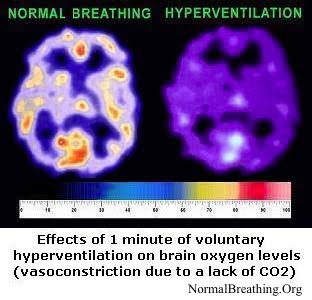 As observed from its prefix “hyper-“, hyperventilation (or alveolar hyperventilation) is breathing more air per minute than the medical norm. The values for normal minute ventilation (or respiratory minute volume) at rest for a 70-kg man range from 4-6 L/min for older physiological textbooks and up to 6-9 L/min for some modern textbooks. Obviously, anything that is more 9-10 L/min is defined as “hyperventilation”.
Hyperventilation causes hypocapnia (CO2 deficiency) in the alveoli of the lungs and, if there is no ventilation-perfusion mismatch, in the arterial blood and other body cells. In any case (too high or too low arterial CO2 – arterial hypercapnia or hypocapnia), hyperventilation always leads to tissue hypoxia (low oxygen levels in cells).
The official story about overbreathing
According to many medical sources, (e.g., Wikipedia, Emedicine.com, and many others), hyperventilation is a condition that happens rarely, and in certain unique situations, such as anxiety and panic attacks. For example, click here. However, these medical sources cannot even provide the correct definition of hyperventilation or “hyper” + “ventilation”. What do we know about the exact numbers for ventilation at rest in people with chronic diseases? Do healthy people have normal minute ventilation rates? How common is hyperventilation? What is the real story related to hyperventilation?
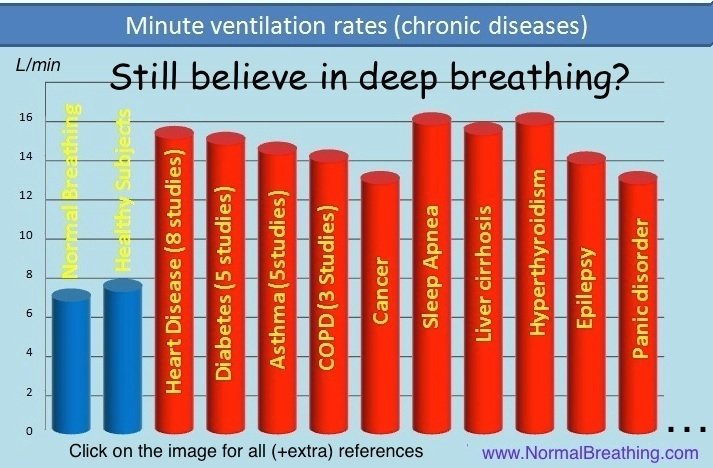
 This data explains the pathological changes and high prevalence of chronic disorders (or diseases of civilization), due to hyperventilation, in the modern population. Since modern people breathe about 2 times more than the medical norm, they usually suffer from low CO2 values in the arterial blood (ventilation-perfusion mismatch is not a very common condition).
Carbon dioxide is a potent dilator of blood vessels (vasodilator) and is crucial for the Bohr effect (O2 transport from red blood cells to tissues). As a result of hyperventilation, modern people experience reduced oxygen levels in the brain, heart, kidneys and all other vital organs. Cell hypoxia causes or favors inflammatory conditions, the production of free radicals and the suppression of the immune system. Apart from these effects, there are devastating effects of the hyperventilation syndrome on the brain due to hypocapnia or a lack of CO2, which has calming or sedative properties on nerve cells. These and other hyperventilation-related physiological effects promote pathological changes and the advance of chronic health problems, such as cancer, heart disease, and diabetes.
Is overbreathing common for ordinary people?
Chronic hyperventilation is very common for ordinary people (or “normal subjects”) these days. Their average minute ventilation values are much greater than the normal value, which used to be the norm about 80-100 years ago.

Minute ventilation (or respiratory minute volume, or flow of air) is the volume of air that can be inhaled (inhaled minute volume) or exhaled during 1 minute. It is used to measure one’s degree of overbreathing.
Prevalence of hyperventilation in the modern population
Based on standard deviations in the above studies related to normal subjects, we can state that over 90% of modern normal subjects breathe more than the medical norms. Therefore, more than 90% of modern normal subjects suffer from chronic hyperventilation. (One can also note that authors of modern yoga books claim that we need to breathe more and expel more CO2.)
This YouTube video (on the right side) provides the definition of and info about the prevalence of hyperventilation: Hyperventilation.
Technical note. If we consider Wikipedia or some other sources saying 5-8 or 6-8 L/min as a normal range for minute ventilation, then hyper means more than 8 L/min. With numerous studies which have found about 12 L/min to be an average and bell-shaped or Gaussian distribution with standard deviation 2-3 L/min (also common), we know that about 90% will be in the range from 10 to 14 or 9 to 15 L/min. The remaining part will have less than the lower range 9 or 10, or higher than the upper range that 14 or 15 L/min. Therefore, less than 10% of subjects (even less than 5%) are within or less than the norm. We can get the same result even if you assume 6-9 or 5-9 as normal values. These are the basics of the theory of probability.
There is a certain minimum number of minute ventilation at rest that provides maximum body oxygenation and amazing health benefits. This number in Liters per minute is provided right below here as your bonus content.
Breathing only about 2 L/min with 3-4 breaths per minute provides 3 minutes for the body oxygen test and about 7-9 minutes for maximum breath-holding using normal air.[/sociallocker]
For clinical techniques that are used by hundreds of medical doctors in order to treat hyperventilation, visit the Section of this site “Breathing Techniques”.
– This page in Spanish: La hiperventilación: ¿Cuán común es?.