- Updated on September 13, 2020
 By Dr. Artour Rakhimov, Alternative Health Educator and Author
- Medically Reviewed by Naziliya Rakhimova, MD
Sleep, Insomnia, Brain Oxygen Levels and Breathing
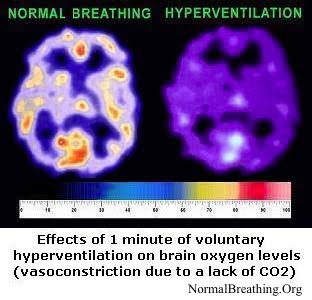 About 10% of Western people suffer from chronic insomnia (Roth T, Roehrs, 2003; Pigeon, 2010) and many more have mild sleeping problems. What are the causes? Over 90% of modern normal people are heavy breathers (see the Homepage with dozens of studies). Sick people breathe even more, as over 50 medical studies testify. This relates to people with heart disease, cancer, diabetes, asthma, COPD, and many other chronic disorders.
As a result, abnormal or ineffective breathing is a key factor that causes insomnia and long sleep since hyperventilation reduces brain O2 and CO2 contents.
Breathing patterns and sleep quality
Clinical observations of Russian MDs resulted in this Table that links body and brain oxygen levels with sleep quality and duration.
| Respiratory Frequency |
Body oxygen test result |
Duration of sleep |
Quality of sleep |
| >26 breaths/min | <10 s | Often >10 hours | Often very poor |
| 15-26 breaths/min | 10-20 s | Often >9 hours | Often poor |
| 12-20 breaths/min | 20-40 s | 6-8 hours | Insomnia possible |
| 7-12 breaths/min | 40-80 s | 4 hours | Excellent |
| 5 breaths/min | 2 min | 3 hours | Excellent |
| 3 breaths/min | 3 min | 2 hours | Excellent |
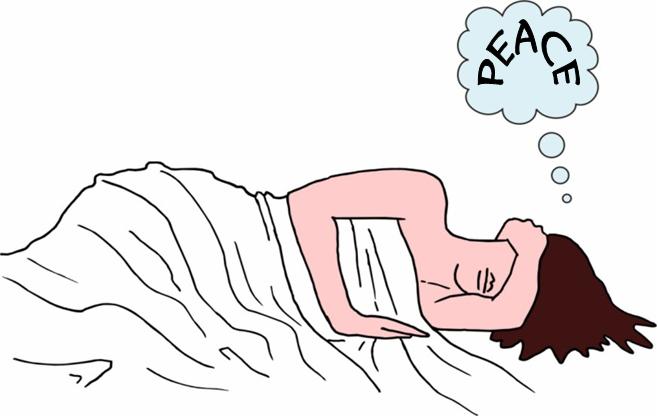 How can we improve sleep quality and stop insomnia? First let us consider this question: Why do we need sleep? Common sense tells us that we need it to provide rest for the brain and muscles. We know that deep breathing makes the brain over-excited (insomnia) (since CO2 is a natural sedative of nerve cells) and muscles tense (since carbon dioxide is a relaxant of muscles). For example, neurological research suggests that hyperventilation “leads to spontaneous and asynchronous firing of cortical neurons” (Huttunen et al, 1999). Do you need any spontaneous and asynchronous signals or thoughts when you go to sleep?
 Hence, CO2 deficiency should affect the quality of our sleep due to these effects. In addition, brain hypocapnia naturally causes brain hypoxia (reduced oxygen content in brain cells). Here are some general practical observations about unconscious breathing patterns and the quality of sleep.
Healthy people have normal breathing at rest (see medical studies from the web page Breathing in healthy). A person with normal breathing (10-12 breaths per minute at rest, 4-6 L/min for minute ventilation, and with about 40-60 s for the body oxygen level):
– falls asleep in less than 1 minute;
– sleeps for about 4-5 hours, with very quiet, light and peaceful breathing, and he or she can stay in the same sleep position the whole night;
– does not remember dreams and does not have nightmares;
– awakes to feel refreshed and full of energy and vigor with a morning CP of about 60 or more seconds.
 Modern people breathe about 12 L/min and have less CO2 and O2 in body cells. Their body oxygen level is about 15-25s and breathing frequency at rest is up to 18-25 breaths per minute. Such a person:
– may need more time to fall asleep (up to 5-30 minutes or more);
– can sleep up to 7-9 hours and in different positions;
– can remember dreams and may have nightmares;
– wakes up feeling tired, often with about 10 seconds CP due to morning hyperventilation.
Why? During the previous day and night, this individual has had chronically low tissue stores of O2 and CO2 due to an ineffective breathing pattern. The muscles were tense, instead of naturally relaxed, and the brain hypoxic and over-excited, instead of calm. Even during sleep, the brain, due to hyperventilation, remained abnormally excited (remember “spontaneous and asynchronous firing of cortical neurons”?) and hypoxic. Hence, most people will suffer from some degree of insomnia and cannot sleep less than 7-8 hours due to their ineffective breathing pattern.
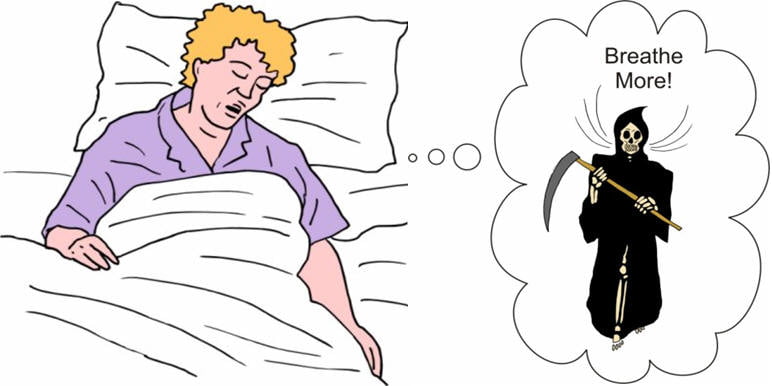 Consider severely sick, terminally ill or hospitalized patients with a typical CP of about 5-10 s or even less. These people:
– may need even more time to fall asleep (up to 30 minutes or more);
– can sleep up to 12-15 hours tossing and turning in bed;
– can remember many dreams and often have nightmares;
– awaken feeling tired and sluggish.
Their quality of sleep is often miserable. Why? It is because these people, due to severe chronic hyperventilation, have critically low oxygenation and CO2 values due to their heavy breathing pattern. They are chronically very tense and over-excited. Their muscles and brain need much more time to rest and relax, and these people often suffer from severe sleeping problems or insomnia. However, relaxing is difficult or impossible, since O2 and CO2 stores are critically low during the night as well. (In fact, severely sick patients are most likely to die during … sleep. See Sleep Heavy Breathing Effect medical research summary.)
Ideal breathing causes ideal sleep
 Some people (Dr. KP Buteyko, some Russian Buteyko doctors, Western Buteyko practitioners and students, and hatha yoga masters) have/had very light or ideal breathing (about 2-3 L/min for ventilation) with 2-3 minutes for the CP (body oxygen level). Such people naturally need only a very short sleep during the night. They simply cannot sleep longer even if they try. Why? High CO2 concentrations keep the muscles relaxed and the brain calm throughout the day and night. Normally these people do not need much sleep at all since they are resting even while they work! (See the picture on the left.) You can reveal the exact number of hours for sleep right below here as your bonus content. You will be amazed!
2 hours.
[/sociallocker]
 Note that there are people who may have only 5-10 s CP and have no problems or complaints about sleep. Occasionally, some people may have 30-35 s CP and still be concerned or unhappy about their quality of sleep. However, all these cases are exceptions rather than the rule. It can be of important practical and scientific value to find out the exact biochemical, neurological and psychological links between breathing and quality of sleep. Why do most people have problems with sleep when they breathe more? Why are some people less affected?
Now we know the answer to the question “How to sleep less naturally?” We should retrain our automatic breathing so that we breathe less and have more oxygen in body cells.
Be observant. If you know the CPs of your friends and relatives, investigate, if possible, whether this general correlation between the CP and quality of sleep is correct for them. Also, check, if it works for you on different days (your CP and sleep quality can vary from day to day due to diseases, infections, exercise, stress, etc.).
Warning. Remember that CP measurements are done until the first desire to breathe. Your health and quality of sleep would not be better if you push yourself to get higher numbers. In fact, if you later gasp for air, your breathing can become even worse. It is how you breathe twenty-four hours a day, seven days a week that matter.
Click on the picture (on the right side) to watch the video clip of insomnia “How to Sleep Less and Better Naturally (Prevent Insomnia and Sleep Problems)
The video discusses the link between basal breathing patterns and the duration of sleep (how to sleep less naturally).
Conclusion: You can sleep less and better if you change your unconscious (basal) breathing pattern so as to have more oxygen and CO2 in the body. Learn Buteyko Breathing Exercises.
Related web pages:
– How to fall asleep fast: Solution for insomnia and sleeplessness, try this simple breathing technique.
– How to sleep less: What is the link between breathing rates and duration of sleep?
References
Huttunen J, Tolvanen H, Heinonen E, Voipio J, Wikstrom H, Ilmoniemi RJ, Hari R, Kaila K, Effects of voluntary hyperventilation on cortical sensory responses. Electroencephalographic and magnetoencephalographic studies, Exp Brain Res 1999, 125(3): p. 248-254.
Pigeon WR, Diagnosis, prevalence, pathways, consequences & treatment of insomnia, Indian J Med Res. 2010 Feb;131:321-32.
Roth T, Roehrs T, Insomnia: epidemiology, characteristics, and consequences, Clin Cornerstone, 2003;5(3):5-15.