- Updated on August 13, 2020
 By Dr. Artour Rakhimov, Alternative Health Educator and Author
- Medically Reviewed by Naziliya Rakhimova, MD
Video: Evolution of Air Causes Chronic Diseases and Low Cells Oxygen due to Low Carbon Dioxide. How is it possible that a human being, one of the smartest species on Earth, can kill itself, and over 90% people die this way, by overbreathing? Is it nature so silly to create this way? In order to answer these questions, we need to consider changes in air composition on Earth and CO2 and O2 evolution. When there was no life on Earth, air has no oxygen (since oxygen is a very reactive substance), while CO2 was a part of the volcanic gases that formed air during those times. Geological studies suggest that CO2 concentration was up to 10-12% or even more.
Thus, when the first organic substances and life forms appeared on Earth (from about 5 billion to 1 billion years ago), our atmosphere did not have any measurable amounts of O2, according to Professor Maina (Maina, 1998), who wrote the book The gas exchangers: structure, function, and evolution of the respiratory processes about development of respiration and breathing in various creatures living on Earth in the past and now. He is one of the leading modern authorities on respiration of different life forms.
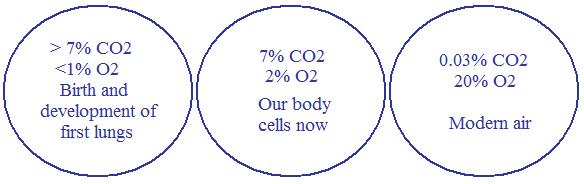
Fig. Carbon dioxide and oxygen: Evolution of air on Earth and body cell O2 and CO2 parameters.
The appearance of the first vertebrates (about 550 million years ago) and the development of prototypes of human lungs took place when the air was made up of only about 1% O2, while having a much higher percentage of CO2 (Maina, 1998), likely over 7%. Normal air today has many times more O2 (about 20%) and only a fraction of the CO2 (0.03%). However, our cells now still live in the air that existed hundred million years ago: “But the cells of animals and humans need about 7 % CO2 and only 2% O2 in the surrounding environment. This is the way how our cells live: cells of the heart, brain, and kidneys” (Buteyko, 1977).
Hence, most of the time our lungs were developing and evolving in conditions when the CO2 content was high (up to 7-12% during the first stages of development), with gradual decline, and low O2 values (about 1% or less during the first stages of O2 evolution). During these stages, the process of control of breathing by the nervous system was also developed. Since this primitive air had very little O2, our evolutionary predecessors could get more oxygen in tissues by breathing more. Since any stressful situation, digestion, search for food, mating, playing, and any other activity required more oxygen, hyperventilation became the fundamental reflex or instinct. Only a totally peaceful stress-free rest had low metabolic rate where heavy breathing would not give any advantage for survival.
On the other hand, however heavy was breathing of these primitive creatures in the past, they would still get the main nutrient, CO2, from the air. The CO2 content in tissues had to be even higher than in air and these creatures would never develop spasms of coronary vessels, bronchi, other smooth muscles, or abnormal excitability of the nerve cells, or muscular tension or any other above-mentioned negative effects. Hence, nature did provide primitive creatures with the ability to function without all above-discussed physiological flaws.
However, the main parameter of our environment, our air, had dramatic change during the later stages of our evolution due to the advance of green life that transforms CO2 into O2 during photosynthesis.
We can see that air had dramatic change during evolution. It now has too much oxygen and almost no CO2. Hence, the chief parameter of our environment (we can survive for days or weeks with no water or food, but only for minutes with no air) became abnormal in its composition. It is the only existence of our lungs that protected us from extinction. Nature could not anticipate this cardinal change in the air, but it did provide us with the means for survival.
For the list of the quoted references click here