- Updated on September 1, 2023
 By Dr. Artour Rakhimov, Alternative Health Educator and Author

(If you want to read about some pseudo-scientific situations that happen with cerebral hypoxia in citizens of the Moon, find and read this Wikipedia article. Here we will focus on real Earth stuff.)
Over 90% people believe that a deep or heavy breathing pattern provides more oxygen for brain cells and vital organs.
Moreover, over 90% of modern people not only believe, they practically “practice” hyperventilation 24/7:

However, overbreathing reduces oxygenation of the human body and all vital organs causing cerebral hypoxia. There is no single medical study, or physiologist, or medical doctor who has proven or shown that overbreathing improves cerebral or body-oxygen levels or is good for us.
“Therefore, I emphasize the fact or law established long ago: the less the depth of breathing, the more the amount of oxygen delivered to the organism, and vice versa, the deeper the breath, the less oxygen is delivered in the organism.” Dr. K. P. Buteyko, “Dr. Buteyko lecture in the Moscow State University on 9 December 1969”
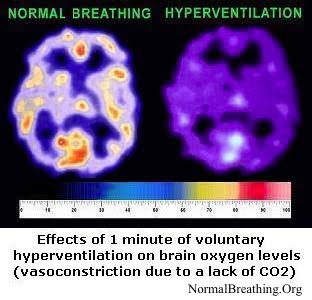 You can test these ideas in practice. If you or somebody else takes a hundred deep and fast breaths, you can easily faint or pass out due to … cerebral hypoxia or reduced oxygenation of the brain. Why? This picture shows brain oxygen distribution for normal breathing and after 1 minute of hyperventilation. O2 availability for the brain is reduced by about 40% as a result of 1 minute of overbreathing (hyperventilation) leading to cerebral hypoxia.
Not only is oxygenation reduced, but transport of glucose crucial to brain functioning is also significantly reduced due to cerebral vasoconstriction.
Cerebral hypoxia is a linear effect
Cerebral vasoconstriction is a linear (dose-dependent) effect. Professor Newton from the University of Southern California Medical Center wrote, “cerebral blood flow decreases 2% for every mm Hg decrease in CO2” (Newton E, Hyperventilation Syndrome 2004 June 17, Topic 270, p. 1-7 – www.emedicine.com).
 A typical sick person (with 12-18 L/min for minute ventilation rates) has, on average, around 20% less oxygen in the brain in comparison with the norm. Their cell oxygenation will be in between these 2 brain images indicating mild cerebral hypoxia.
Not only the brain, but all other vital organs will suffer from less oxygen in conditions of hyperventilation.
<!–
References
- Cerebral hypoxia (From Wikipedia.org)
- Cerebral hypoxia (From MedlinePlus.gov)
- Brain Hypoxia (From HealthLine.com)
–>