Breathing Less Header
Homepage Patterns CO2 effects Causes Diseases Symptoms Life quality Books ... Downloads More ... Search Map
Techniques Yoga Buteyko Frolov device Learn here Teaching Practitioners Testimonials Fitness Social issues Children
RSS feed

How to Stop a Runny Nose (Get Rid of It Fast)

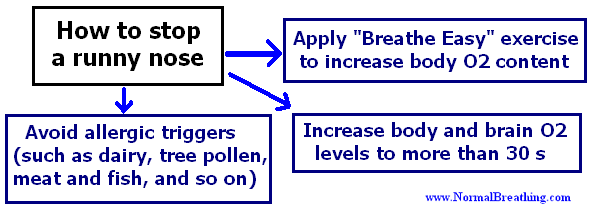
How to stop a runny nose (plan)How to stop a runny nose? Three crucial steps are shown on this diagram (on the left side).

Not all people get a runny nose due to allergic rhinitis. In more rare cases, a running nose can be due to a brain trauma. In other cases, overuse of nasal sprays can lead to a running nose. Certain other foods (e.g., spices) and other irritants may also trigger this condition. Obviously, the triggers need to be avoided.
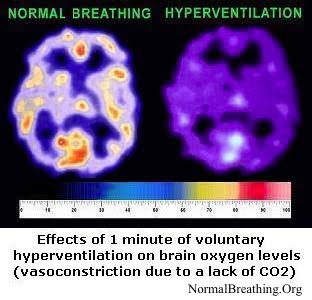
Womna with a runny noseBrain O2 levels: changes after overbreathingA runny nose and allergies can appear only when one's body and brain O2 levels are much less than the physiological norm (40 seconds). Usually it is even less than 20 seconds for the DIY body-O2 test. Tissue hypoxia is caused by ineffective breathing (too fast and heavy breathing). This makes the immune system weak and hypersensitive. Additional causes of low body and brain O2 are chest breathing (which reduces blood oxygenation) and mouth breathing (which leads to losses of blood levels of CO2 and nitric oxide generated in sinuses).

How to Get Rid of a Runny Nose Remedy (Breathe-Easy Exercise)

Get flash player to play to this file

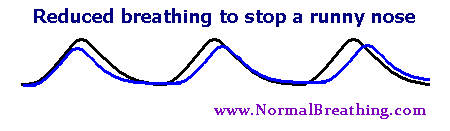
Pinch your runny nose and walk fast with your running nose pinched. (Your mouth should be closed all the time.) You need to get more arterial CO2 to dilate arteries and arterioles (CO2 is the most potent dilator of arteries and arterioles). You will probably make about 15-25 steps. While walking, you should hold your breath until a strong desire to breathe appears. Afterwards, sit down with your spine totally straight.  After you release your nose, start reduced breathing (breathing less air than before this exercise). How? Instead of taking your usual big and frequent inhalations, take a smaller inhalation and using the diaphragm only. Then relax all muscles for an exhalation and repeat the cycle. Make another short inhalation and again just relax to exhale. Practice this reduced breathing while remaining relaxed.
How to stop a runny nose exercise(chart)

Your purpose is to maintain air hunger (shortage of air) for several minutes with total relaxation of body muscles. If your brain and body-O2 levels are low, it is normal that your breath pattern will be frequent during this exercise. This breathing exercise "how to stop a runny nose" increases brain and body-O2 content by about 3-5 seconds.

If you practice this exercise for hours every day, you can expect quick health recovery. There are many additional lifestyle changes that help to increase brain and body O2. Study this site for more details.

How to stop a runny nose during night sleep

Woman sleeping with nose breathingYou need to lie on your left side or chest and relax all bodily muscles (Sleeping sitting causes less problems with a runny nose.). Pinch your nose, hold your breath until air hunger, and then follow the same instructions for reduced breathing as above. So that your nose does not get runny again, you should increase your body O2, using breathing exercises and lifestyle changes, up to 20 seconds. The same exercise will help you to fall asleep much faster too.

How to get rid of runny nose for good

These are conclusions (below) of over 100 Soviet and Russian MDs who tested and cured thousands of people with rhinitis and other conditions leading to a runny nose:

- If your body-O2 test results are more than 30 s all the time, your immune system will be much stronger, and you will not suffer from colds or the flu.

- If, in addition to the previous condition, you can avoid your allergic triggers for about 2-3 months, then this time should desensitize your immune system to your allergic triggers. Therefore, you can get rid of a runny nose and all your allergies (to tree pollen, cat proteins and all other triggers).

This is the permanent solution (how to get rid of runny nose for good) found by medical doctors to permanently solve problems with a runny nose.

Related web pages:
How to tape mouth at night - Mouth taping technique to prevent mouth breathing during sleep
Mouth vs. nose breathing - Medical review of main physiological effects
Sleep positions medical research (26 studies - What is the best way to sleep for maximum body oxygenation?)
How to prevent sleeping on one's back - Practical techniques and permanent solutions
Clear stuffy nose in 1-2 min - Easy remedy with permanent solution
Internet lies about ideal sleep positions - Over 90% of internet resources advice sleeping on one's back.

References

Bartley James, Nasal congestion and hyperventilation syndrome, American Journal of Rhinology, 2005 Nov-Dec; vol 19(6): p. 607-11.

Waitemata District Health Board, Auckland, New Zealand.
Abstract
BACKGROUND: This article evaluates the prevalence of hyperventilation syndrome (HVS) in patients who continue to complain of ongoing nasal congestion, despite an apparently adequate surgical result and appropriate medical management.
METHODS: Prospective case series of 14 patients from June 2002 to October 2003 was performed. Patients, who presented complaining of nasal congestion after previous nasal surgery and who appeared to have an adequate nasal airway with no evidence of nasal valve collapse, were evaluated for HVS. When appropriate, nasal steroids and oral antihistamines also had been tested without success. Three patients had end-tidal P(CO2) levels measured and five patients underwent breathing reeducation.
RESULTS: All patients had an elevated respiratory rate (>18 breaths/minute) with an upper thoracic breathing pattern. Twelve of the 14 patients complaining of nasal obstruction had an elevated Nijmegen score indicative of HVS. An average number of 2.5 procedures had been performed on each patient. End-tidal P(CO2) levels were < or = 35 mmHg in the three patients who had expired P(CO2) levels measured. Breathing retraining was successful in correcting the nasal congestion in two of five patients.
CONCLUSION: HVS should be included in the differential diagnosis of patients presenting with nasal congestion, particularly after failed nasal surgery. One possible explanation is increased nasal resistance secondary to low arterial P(CO2) levels. Another possible explanation is reduced alae nasae muscle activity secondary to the reduced activity of serotonin-containing raphe neurons. Additional surgery may not necessarily be the answer in HVS patients complaining of nasal congestion.

Reference pages: Breathing norms and medical facts:
- Breathing norms: Parameters, graph, and description of the normal breathing pattern
- 6 breathing myths: Myths and superstitions about breathing and body oxygenation (prevalence: over 90%)
- Hyperventilation: Definitions of hyperventilation: their advantages and weak points
- Hyperventilation syndrome: Western scientific evidence about prevalence of chronic hyperventilation in patients with chronic conditions (37 medical studies)
- Normal minute ventilation: Small and slow breathing at rest is enjoyed by healthy subjects (14 studies)
- Hyperventilation prevalence: Present in over 90% of normal people (24 medical studies)
- HV and hypoxia: How and why deep breathing reduces oxygenation of cells and tissues of all vital organs
- Body-oxygen test (CP test) : How to measure your own breathing and body oxygenation (two in one) using a simple DIY test
- Body oxygen in healthy: Results for the body-oxygen test for healthy people (27 medical studies)
- Body oxygen in sick : Results for the body-oxygen test for sick people (14 medical studies)
- Buteyko Table of Health Zones: Clinical description and ranges for breathing zones: from the critically ill (severely sick) up to super healthy people with maximum possible body oxygenation
- Morning hyperventilation: Why people feel worse and critically ill people are most likely to die during early morning hours

References: pages about CO2 effect:
- Vasodilation: CO2 expands arteries and arterioles facilitating perfusion (or blood supply) to all vital organs
- The Bohr effect: How and why oxygen is released by red blood cells in tissues
- Cell oxygen levels: How alveolar CO2 influences oxygen transport
- Oxygen transport: O2 transport is controlled by vasoconstriction-vasodilation and the Bohr effects, both of which rely on CO2
- Free radical generation: Reactive oxygen species are produced within cells due to anaerobic cell respiration caused by cell hypoxia
- Inflammatory response: Chronic inflammation in fueled by the hypoxia-inducible factor 1, while normal breathing reduces and eliminates inflammation
- Nerve stabilization: People remain calm due to calmative or sedative effects of carbon dioxide in neurons or nerve cells
- Muscle relaxation: Relaxation of muscle cells is normal at high CO2, while hypocapnia causes muscular tension, poor posture and, sometimes, aggression and violence
- Bronchodilation: Dilation of airways (bronchi and bronchioles) is caused by carbon dioxide, and their constriction by hypocapnia (low CO2)
- Blood pH: Regulation of blood pH due to breathing and regulation of other bodily fluids
- CO2: lung damage: Elevated carbon dioxide prevents lung injury and promotes healing of lung tissues
- CO2: Topical carbon dioxide can heal skin and tissues
- Synthesis of glutamine in the brain, CO2 fixation, and other chemical reactions
- Deep breathing myth: Ignorant and naive people promote the idea that deep breathing and breathing more air at rest is beneficial for health
- Breathing control: How is our breathing regulated? Why hypocapnia makes breathing uneven, irregular and erratic.

Or go back to Hyperventilation symptoms


Your social engagement and comments are appreciated. Thanks.

HTML Comment Box is loading comments...
Disclaimer Copyright 2013 Artour Rakhimov Contact details