- Updated on September 10, 2020
 By Dr. Artour Rakhimov, Alternative Health Educator and Author
- Medically Reviewed by Naziliya Rakhimova, MD
Edited by J diFeliciantonio on February 25, 2020
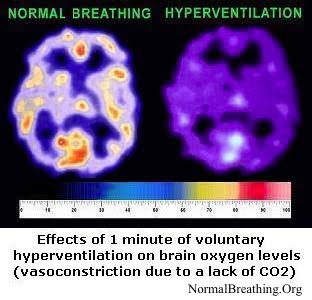
Fall Asleep Faster (in 1-2 Min) | Meditation Breath Technique
Below, I discuss a simple breathing remedy that can help you fall asleep very fast.
In essence, it’s a mindfulness meditation technique with roots in the ancient Sanskrit text The Vigyan Bhairav Tantra (approximately 5000 years old). Most people who use this natural breathing remedy, my students included, report falling asleep in about 1 to 3 minutes (i.e., 5 to 10 times faster than usual). In fact, over 150 Soviet and Russian medical doctors have applied this technique with striking success on thousands of patients; even those patients suffering from cold feet and hands, chronic coughing, or blocked nose have found success.
Dr. Buteyko, a prominent Soviet doctor who studied breathing in the late 20th century, along with his MD colleagues, discovered that breathing and fall asleep actually go hand in hand. More specifically, Buteyko observed that automatic (or unconscious) breathing patterns during sleep affect the results of the morning CP or body-oxygen test, which has everything to do with the quality and natural duration of sleep. The chart below explains these relationships.
| Respiratory Frequency |
Body oxygen test result |
Duration of sleep |
Quality of sleep |
| >26 breaths/min | <10 secs. | Often >10 hours | Often very poor |
| 15-26 breaths/min | 10-20 secs. | Often >9 hours | Often poor |
| 12-20 breaths/min | 20-40 secs. | 6-8 hours | Insomnia possible |
| 7-12 breaths/min | 40-80 secs. | 4 hours | Excellent |
| 5 breaths/min | 2 min | 3 hours | Excellent |
| 3 breaths/min | 3 min | 2 hours | Excellent |
This data is based on the physiological law that slower and lighter breathing at rest provides more oxygen and CO2 to brain cells, improving sleep quality, reducing sleep quantity, and enabling a person to fall asleep faster.
The fall asleep faster technique: Setting the conditions
Before using the technique for Fall Asleep, it’s important to set healthy conditions for sleep.
– Go to bed only when you are really sleepy. And ensure there’s no food in the stomach. (For most people, this means at least 3 hours after a light meal and 4 hours after a large meal; allowing 5+ hours after a meal to sleep, is even better.)
– As you settle in for sleep, make sure to breathe only through your nose. (If you cannot do this, use the “breathing exercise to unblock the nose.”) You may even place a small strip of medical tape on your mouth, so that your mouth does not fall open while you sleep.
– Choose a sleeping position on your side or stomach. Avoid sleeping on your back. If you find it difficult not to sleep supine, or if you frequently start on your stomach/side and wake up on your back, check out the following page: “How to prevent sleeping on the back.” (You can also review the negative effects of supine sleep, here at “Best sleeping positions,” which summarizes 24 clinical studies conducted on the best postures for sleeping.)
You may also wish to review this guide from Oregon State University on healthy sleep hygiene.
Instructions: Falling asleep fast
 Once you’ve created healthy conditions for sleep, do the following.
Relax all your muscles (lying in bed on your stomach or left side). Then focus on your breathing pattern, until your breathing is consistently within your attention. Next, instead of taking your usual inhalation, take a slightly smaller inhalation (only about 5% to 10% less) using the diaphragm. Once this mini inhalation is complete, immediately relax all body muscles, especially the upper chest and all other respiratory muscles, to exhale. Take another (smaller) inhalation. Again, completely relax to exhale.
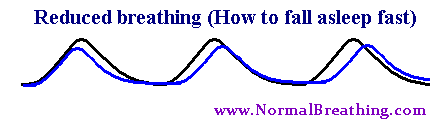
This exercise is called “reduced breathing.” In essence, with each breath, you take a smaller or reduced inhalation — in comparison with your usual breathing — and then completely relax for exhalation. If you do this process correctly, you should experience a light shortage of air, or what is called “air hunger.” Your goal is to preserve this mild but comfortable level of air hunger. Doing this, you will fall asleep faster.
The two lines below illustrate reduced breathing. The black line represents the initial breathing pattern, the blue line the new breathing pattern corresponding to this mindfulness technique.
 If you are in poor health, this exercise can induce your breathing to happen more frequently, and that’s okay. Still, if you breathe less air than usual and maintain slight air hunger, you will be able to fall asleep faster.
If you do this exercise correctly, you will notice the following signs:
– Your arms and feet will warm up in about 1 to 2 minutes. This sign is key.
– Your nasal passages, in about 1 min., will become more moist and your nose may feel slightly colder, depending on the ambient temperature.
The essence of falling asleep instantly (in less than 1-2 min) every night
The bottom line is, if you want to fall asleep very fast on a regular basis, you must maintain high body-O2 content, namely by slowing down your breathing. There are many lifestyle changes, discussed on this website, that can increase body-O2 content and improve your sleep quality. (A short summary of these factors is listed in the below table as bonus content.)
 Warning. Calcium deficiency can make the quality of your sleep much worse and prevent your progress toward deeper states of meditation and improved health. Learn how to check for and correct this nutritional deficiency here: “Major Nutrients Guide for Body Oxygenation.”
This video, by Dr. Artour Rakhimov, also details how breathing can help one fall asleep faster.
Why is it so hard for modern people to fall asleep?

The medical healthy level for breathing at rest is 6 liters/min. of air. However, most people today breathe 10 to 12 L/min. Approximately 2 times more air! The consequence is that modern people have twice less partial O2 pressure in brain cells, and lower CO2 and O2 concentrations not just in the brain but throughout the body.
This is important, because carbon dioxide is a potent sedative and tranquilizer of nerve cells. (See links to web pages with medical studies below.) Ever had a night of racing, nonstop thoughts that wouldn’t allow you to sleep? This kind of overexcited nervous system activity correlates with low CO2 concentrations in the body.
After testing hundreds of my breathing students, I have witnessed first-hand how sleep quality and duration (in hours) connect with the body oxygen test and breathing frequency. The bonus content below provides exact numbers in table format. Find out the lifestyle factors that, combined, can allow a person to sleep naturally (without trying) for 4 hours. (Or even 2 hrs!) In such states, people call fall asleep in seconds.
Summary Table: How to Sleep Better (Good Sleep Hygiene Guide)
| Parameters | Sleep quality: | |
| Good | Poor | |
| Allergic reactions during the day |
Avoided | Present |
| Time spent outdoors | Up to 2-5 hours daily | Less than 1 hour |
| Physical exercise with strictly nasal breathing | Up to 1-3 hours daily | Less than 1 hour |
| What to do before sleep | Walk for 15-20 min outdoors or even light jogging; 15-20 min breathing exercises; early meal before sunset; cold shower; correct posture | Watch TV, play games, or work on a computer; overheating; late meal and/or overeat; slouch in an armchair, or on a couch or sofa |
| When to go to sleep | When really sleepy | By time |
| Type of materials that are in touch with skin during sleep | Natural (e.g., cotton, hemp, wool) | Synthetic (polyester, acrylic, nylon) |
| Air quality in the bedroom | Excellent | Poor |
| Thermoregulation | If your CP<20 secs., target feeling normal or little warm during sleep; If your CP>20 secs., target feeling little on the cold side during sleep. |
Too warm, too many blankets, temperature too hot in room |
| Bed surface | Hard (i.e., sensation of lying on 2 thin blanket layers spread out on a hard surface) | Soft |
| Sleep positions | Sitting (best), prone on stomach, left side | On one’s back (worst), right side |
| What to do to fall asleep | Buteyko reduced breathing exercises | Worry about life problems tomorrow and poor health now |
| What to do, if no sleep for more than 10 min | Get out of the bed, go for a walk outdoors, or do a breathing session | Continue to suffer |
| What to do in the morning | Measure the CP and get out of the bed | Continue to lie horizontally |
| What to do during the day in cases of mild sleep deprivation (or when sleepy, over 40s CP) | Get a short nap (e.g., 5-20 min) sitting (e.g., in an armchair) | No nap, or napping in a horizontal position |
| What to do during the day in case of severe sleep deprivation | Try to sleep sitting, if possible, for as long as the body needs in optimum sleep conditions. | Get upset by a sleepless night and try to sleep without caring for sleep hygiene. |
[/sociallocker]
You can find more information, with more useful details and a systematic approach to improving sleep and related lifestyle factors, in Dr. Artour Rakhimov’s book “Sleep Better and Less – Naturally.”