- Updated on August 3, 2026
 By Dr. Artour Rakhimov, Alternative Health Educator and Author
- Medically Reviewed by Naziliya Rakhimova, MD
 This easy exercise to increase body-oxygen levels and cure a stuffy nose fast was applied by Soviet MDs. Around 200 Russian doctors have taught this most natural remedy to thousands of their patients with mouth breathing problems, sinusitis, rhinitis, and other conditions.

Most patients, according to the clinical experience of these doctors, could clear their stuffy nose, stop mouth breathing, and resume their nasal breathing in about 1 minute naturally. This remedy also works for people with chronic-stuffy-nose problems and symptoms of fatigue or for people with allergies or a sore throat. This exercise can be applied at night or before sleep as well (see below).
You can read the instructions below or watch this YouTube with the same instructions: How to Get Rid of Your Stuffy Nose. This video has hundreds of positive testimonials on YouTube. Check it out.
Get Rid of a Stuffy Nose: Solutions (Remedy)
 Pinch your congested nose and walk fast with your blocked nose pinched and your mouth closed the whole time. (You need to accumulate CO2 to dilate arteries and arterioles.) You probably will be able to make around 20-30 steps. While walking, keep the body relaxed and hold your breath until you have a strong urge to breathe. Then sit down with your spine totally straight and focus on your breath.
After you release your nose, you need to breathe less air. Here is how you do that. Keep the mouth closed (no large or deep inhalations and no gasping for air) and start reduced breathing (breathing little bit less than before this exercise). How? Instead of taking a big (or deep) inhalation, take a smaller one, but using the diaphragm only. Then, relax all muscles for exhalation.
Repeat the cycle. Make another shorter inhalation and again relax the muscles of the body. With each inhalation, keep practicing this reduced breathing while remaining relaxed.
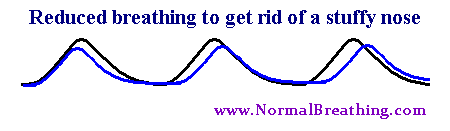
Your purpose is to maintain a feeling of air hunger (shortage of air) for about 1-2 min with total relaxation of body muscles as during meditation. It is normal that your breathing will become more frequent during this reduced breathing. The crucial part here is to accumulate CO2 that will dilate blood vessels and provide more oxygen for body cells.
If later your breathing becomes heavy, your nose is likely to get blocked again. Then you can again apply this remedy. It can be used many times per day.
How to get a stuffy nose clear during night sleep or before bed
 Lie in bed on your left side or chest and completely relax all muscles. For more effective relaxation, tense the upper part of the body or the whole body for 3 seconds and then relax. Pinch your stuffy nose and follow the above instructions related to breath holding and reduced breathing (see the graph above) to achieve a quick relief. The same exercise will help you to fall asleep faster too.
Get rid of stuffed nose fast with exercise (Training Mask for nose breathing)
If you like to exercise, you will love this amazing remedy to fix sinus congestion very fast with intense exercise and strict nose breathing (in and out).
In this YouTube video below, Volker Schmitz, one of our breathing practitioners from Hamburg (Germany) shares his great success story (testimonial) about how he cured sinusitis fast and naturally by exercising (running) with the Training Mask and 100% nose breathing and the strong cleansing reaction he got (tons of old mucus coming out fast in one exercise sessions!). But one can get a similar success with other methods.
Permanent remedy (get rid of a blocked nose forever)
Hundreds of my breathing students restored their nose breathing permanently. No more stuffy nose problems… Never … It happened when they achieved and maintained a certain result for a simple test that we use to measure breathing and body oxygen (the CP test). Find out about this requirement in the bonus content.
The cure to chronic nasal congestion is to increase your body-oxygen content up to about 25 seconds 24/7. If your body-oxygen test results are more than 25 seconds all the time, your stuffy nose will be clear all the time. If your body oxygen level drops below 20 s, (e.g., due to poor air quality, overeating, big meals, allergies, mouth breathing, or supine sleep in bed), your nasal passages get blocked again due to extra mucus, advance of pathogens, and other effects of low-cell-oxygen levels.
[/sociallocker]
Related web pages:
Study claims hyperventilation causes sinusitis
Bartley James, Nasal congestion and hyperventilation syndrome, American Journal of Rhinology, 2005 Nov-Dec; vol 19(6): p. 607-11.