- Updated on August 13, 2020
 By Dr. Artour Rakhimov, Alternative Health Educator and Author
- Medically Reviewed by Naziliya Rakhimova, MD
This YouTube video interview features Dr. Artour Rakhimov. He explains causes and treatment for night sweats.
 Night sweats (or Sleep Hyperhidrosis or cold night sweats) are defined as periods of nighttime sweating that makes your nightclothes or bedding wet even in conditions of normal thermoregulation.
One of the most common causes of sweating at night in women over 40 yo is the hormonal changes related to menopause and perimenopause. There are many medical conditions that can cause night sweats in men and women. They range from infections and hypoglycemia and to HIV/AIDS and cancer-causing cachexia.
Many medical drugs and even supplements (antidepressants, antipyretics, hormones, hypoglycemic agents, tamoxifen, nitroglycerine, niacin, and Viagra) exacerbate or even trigger problems with night sweats.
Key causes of night sweats
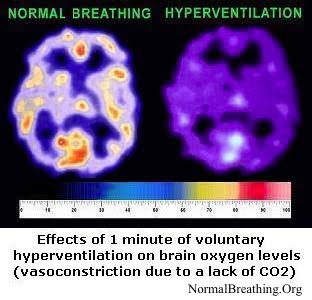 However, in the overwhelming majority of cases, the key underlying cause of night sweats is low body oxygenation due to positive static electricity of the human body, mouth breathing, supine sleep, chest breathing and hyperventilation. All these factors lead to low tissue O2 concentrations and promote chronic inflammation, immunosuppression, dysregulation of hormonal changes, cachexia, and many other pathological effects.
The image on the left shows the effects of overbreathing in a person who breathes more than the medical norm. A similar picture takes place during night sweats due to heavy and fast breathing.
The Table below explains why sweating at night is very common in modern people (both men and women) but are very rare during the first decades of the 20th century.
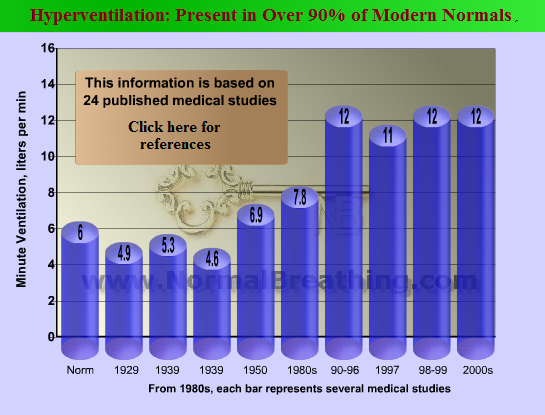
Nearly all cases of night sweats occur in people who have less than 20 seconds for the body-oxygen test, while the norm is about 40 seconds. (Dr. Buteyko’s norm is 60 s.) Night sweats become severe when the body-O2 content is less than 10 seconds or more than 4 fold below the norm.
How to get rid of sweating at night
There are various methods and techniques that immediately lead to a nearly double reduction in intensity and severity of night sweats. Thus, you can stop night sweats using the following techniques:
– Grounding your body for normalization of its electrical properties (Earthing)
– By preventing mouth breathing
– By preventing supine sleep
– A simple breathing exercise to reduce the severity of night sweats (the same exercise is used to stop cramps and muscle spasms).
However, in order to stop sweating at night completely and to get rid of night sweats for good, one needs to get up a certain number for the morning body-oxygen-test results. For example, people with cancer do not experience night sweats when they get up to this number in seconds for their body-oxygen test (with daily CPs even higher). However, menopausal hot flashes in females require slightly larger numbers for the morning body O2 in order for their symptoms to disappear. These exact numbers are provided as your bonus content right here below (in the next paragraph). My breathing students found that these numbers are true for them too.
You need to get 25-30 seconds for the morning CP in cases of night sweats for males, and up to 35+ s CP 24/7 for females.
[/sociallocker]