- Updated on October 29, 2020
 By Dr. Artour Rakhimov, Alternative Health Educator and Author
- Medically Reviewed by Naziliya Rakhimova, MD
 The term “shortness of breath” is a myth that was invented and has been promoted by people who are not educated in basics of respiration and oxygen transport. (It is not important that these people can have high positions and titles in states or medical/university organizations since we are looking for truth.) The implication of this phrase (and myth) is that some people can have “short” breaths and suffer from reduced oxygen levels in body cells. Therefore, there are dozens of world’s largest websites that provide pathetic help to people claiming that there is such a thing as “shortness of breath”.
It is true that people can develop the sensation of air hunger or a shortage of air (especially during pregnancy, or due to allergies or anxiety, or last stages of nearly any chronic diseases ranging from cancer, heart disease, diabetes and COPD to HIV-AIDS and cystic fibrosis ) as if they are not getting enough air (or oxygen). However, the reality is very simple: nearly all those people who complain that they are not getting enough air at rest have no clue that there is a tiny medical norm for breathing at rest, and that overbreathing (hyperventilation) creates oxygen deficiency in tissues due to CO2 losses.
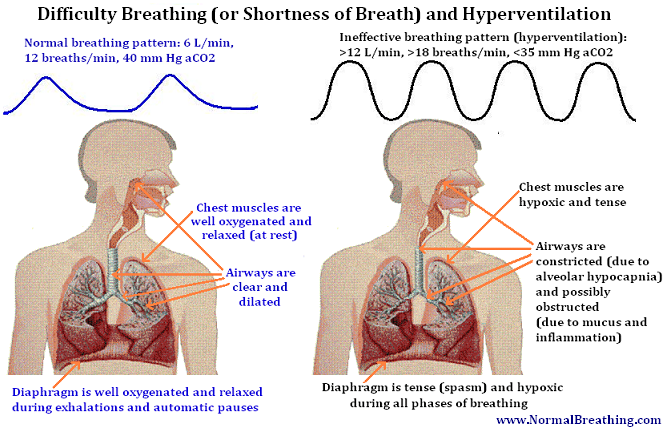
Each person with shortness of breath suffers from low body O2 content caused by overbreathing. Two additional factors (mouth breathing and chest breathing) worsen this sensation of air hunger or dyspnea.
Every person with claimed shortness of breath suffers from fast and usually deep breathing (increased tidal volume) at rest. This causes reduced CO2 levels in airways and reduced brain and body oxygenation.
Here are results of clinical studies (over 30 in total) that show the exact measurable cause of air hunger or desire to breathe more. Heavy breathing, as hundreds of clinical studies testify, is present in people with nearly any chronic disease.
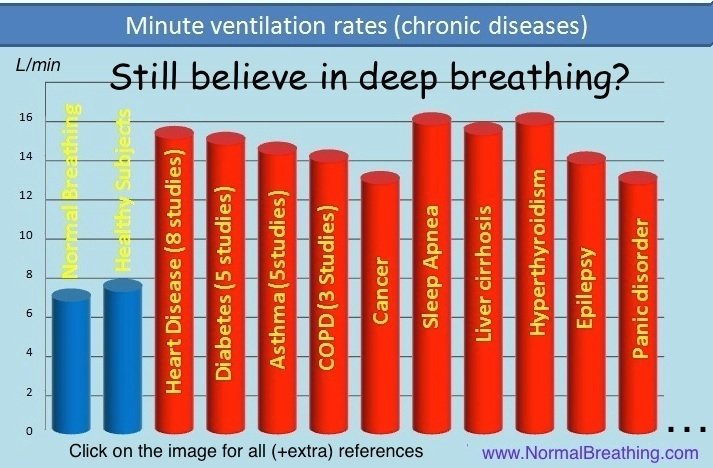
Why would one support this silly idea that their breath (i.e., tidal volume) is short when in reality they take nearly twice more air than the medical norm (about 500 ml for a 70-kg adult)? If you do not believe, search online for “shortness of breath” and discover that leading medical charlatans never provide any numbers or any exact data to define shortness of breath.
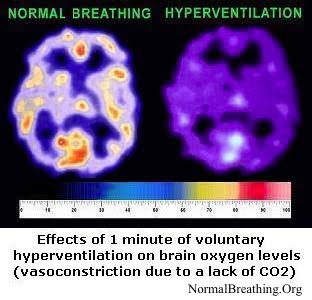
How then overbreathing causes air hunger or sensation of a shortage of air? Hyperventilation leads to CO2 deficiency in the lungs and blood (we assume no problems with ventilation-perfusion ratio). Since carbon dioxide is the most potent vasodilator, hypocapnia (CO2 deficiency) causes constriction of smooth muscles of arteries and arterioles leading to tissue hypoxia (or low cell-O2 levels). This is true for the brain (see the image above), heart, colon, stomach, liver, and all other vital organs, as independent research studies confirmed.
Shortness of breath can appear only in people who have less than 20 seconds for the simple DIY body-oxygen test. If this person gets over X s for body and brain oxygenation, his or her shortness of breath disappears: easy natural treatment. This is the experience of over 100 Soviet and Russian MDs who tested over 50,000 of their patients with air hunger. My breathing students reported the same results. Find out this number X in your bonus content right below here.
Generally, you need to get 25-30 s for the morning CP, but, for most people, even 20 s for the morning body O2 test is anough to get rid of this symptom.
[/sociallocker]
Here is a short video about shortness of breath:
Why then do people have this weird desire to breathe even more when they already breathe 2-4 times more air at rest than the medical norm? This is a tricky topic that is explained on a page that analyzes dramatic changes in air composition on Earth and how these changes converted hyperventilation from something that was very useful (when O2 levels were very low and CO2 was above 5-7%) into the main pathological reflex that causes millions of deaths every year: pathological reflexes.