Fast Constipation Pain Relief (1-2 Min Breathing Exercise)
Thousands of people can testify that this is an exceptionally easy
and fast method to relieve the pain and suffering of constipation and
the abdominal pain caused by it. Moreover, this is the only technique
that addresses the root cause of constipation and constipation pain.
The spasm in the smooth muscles of the GI tract appeared due to a lack
of 2 crucial nutrients in the body and the digestive tract: carbon
dioxide and oxygen. How could it appear? Concentrations of both these
chemicals are controlled by our breathing patterns. Hence, the answer
is in breathing normalization or breathing in such a way that is closer
to the normal breathing pattern. The
success rate for this exercise has been dependent on instructions
provided by Buteyko breathing method educators who explained this
exercise to their students.
Constipation remedy breathing exercise (relief in 2-3 min)
This natural
and easy breathing exercise to relieve constipation (and even its pain) was invented
by Soviet medical doctors. Hundreds of Russian and Soviet doctors have taught
this breathing remedy to thousands of their patients with chronic constipation,
including pregnant women and children.
1. Do this exercise when you sit on the toilet while squatting using strictly nasal breathing. (Patients with hypertension and those at risk of stroke should avoid squatting and urge their physicians to check squatting blood pressure while monitoring anti-hypertensive therapy before trying this exercise. Furthermore, these patients should avoid long breath holds due to rise in blood pressure. Their instruction is provided below.)
2. Take a slow inhalation using your abdominal muscles or belly (as if filling your belly with air) and exhale by relaxing your diaphragm. (This slow and deep breath increases blood oxygen levels since people with constipation are usually chest breathers.)
3. At the end of this slow relaxed exhalation, pinch the nose and hold your breath until you experience strong air hunger. (People with heart disease, seizures, panic attacks and frequent migraines should avoid extended breath holding and use the easier version provided below.)
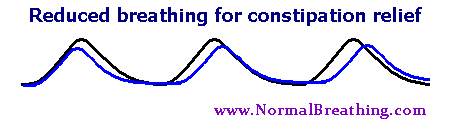
4. When you release the nose, instead of your natural desire to take
a deep inhalation, take a shorter inhalation using your diaphragm and then
immediately relax it. Your goal is to maintain strong air hunger
for 1-2 minutes, while having this reduced
breathing with total relaxation of all body muscles.
If you do this exercise, increased O2
and CO2 concentrations will bring quick relief from constipation and possible pain.
For people with heart disease and panic attacks
These groups of people require a different version of the breathing exercise to relieve constipation. They should use a different approach with more gentle changes in CO2 and O2 in the lungs and blood. Instead of a sudden CO2 surge (as during breath holding), these people start with step 4 above: only reduced breathing while gradually increasing air hunger level.
Physiological foundation of success
Decreased ventilation leads to gradual accumulation of carbon
dioxide in the lungs, blood, and all other body tissues. Carbon dioxide
is a relaxant of all smooth muscles (Natural Muscle Relaxant), a
dilator of the arteries (CO2 Vasodilation),
restorer of the tone of veins, and a catalyst of chemical release of
oxygen from hemoglobin (the Bohr effect).
Therefore,
elevated CO2 level in the arterial blood naturally produces muscular
relaxation, improved blood and oxygen supply, relief from venous blood congestion,
and increased oxygen release in tissues. All these effects naturally remove
spasm in the GI muscles and bring immediate
constipation pain relief.
Long-term solution for constipation pain: normalize your breathing patterns
Our
unconscious respiration pattern has powerful effects on cell oxygen levels and
blood supply to all tissues. Respiratory measurements have clearly proven that modern people breathe about 2 times air than
the medical norm requires for overall health. As a result, they have
reduced brain and body oxygen stores. Sick people breathe even more
than 2 times the medical norm.
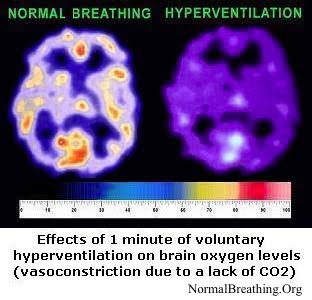
It is important to emphasize again that over-breathing (i.e. hyperventilation) DECREASES body oxygen content due to vasoconstriction (less blood supply for all vital organs due to CO2 deficiency) and the suppressed Bohr effect (less oxygen released in capillaries by red blood cells due to the same cause, low CO2 in the arterial blood). Chest breathing has been shown to be an independent factor contributing to lower body oxygen due to reduced blood oxygenation.
If
you retrain your unconscious respiratory pattern, so that you have more than 25
s for the body oxygen test, your problems with pain
from constipation and many other common symptoms of chronic diseases will
disappear.
Hence, the permanent answer to the problem with constipation pain relief is to have normal breathing 24/7. Then you have normal body and colon oxygen levels, normal gastric and rectal motility, normal gut flora, normal phasic contractility and many other fundamental gut parameters.
Apart from breathing exercises, numerous Hyperventilation Causes influence breathing and body oxygen content. All these practical details and their theoretical background can be found on this website.
How automatic breathing parameters relate to spasms and cramping
(muscle, stomach, leg cramps in bed, period or menstrual cramps, and many others)
with the permanent way to get rid of cramps and spasms
| Respiratory Frequency* | Body Oxygen Test (morning result) |
Chances of cramps |
| More than 20 breaths/min | Less than 20 s | Very possible |
| 15-20 breaths/min | 20-30 s | Possible |
| 12-15 breaths/min | 30-40 s | Very rare |
| 12 or less breaths/min | > 40 s | Virtually impossible |

* You cannot measure your respiratory frequency just by counting it (more info: Breathing Rates)
Reference Web Pages: Breathing norms, Medical Graphs and Tables about Breathing Rates (Minute Ventilation) and
Body Oxygen in Healthy, Normal and Sick People
Breathing
norms Parameters, graph, and description of the normal
breathing pattern
6 breathing myths 6
myths about breathing and body oxygenation (prevalence: over 90%)
Hyperventilation Definitions of
hyperventilation: their advantages and weak points
Hyperventilation Syndrome in the
Sick. Table
1. Western scientific evidence about prevalence of CHV
(chronic hyperventilation) in patients with various chronic conditions
(34 medical studies)
Normal Minute Ventilation in
Healthy Subjects: Easy and Light Breathing (14 Studies)
Hyperventilation Prevalence Present in Over 90% of
Normal People (24 medical publications)
HV and hypoxia
How and why deep breathing reduces oxygenation of cells and tissues of
all vital organs
Body oxygen test
How to measure your own breathing and body oxygenation (a simple DIY test)
Body oxygen in healthy
Table 4. CP (body oxygen level) in healthy people (27 medical
studies)
Body oxygen in sick Table 5.
CP (body oxygen level) in sick people (14 medical studies)
Buteyko
Table of Health Zones with clinical description of most common zones
Morning HV Morning
hyperventilation effect or how and why critically ill people are most
likely to die during early morning hours
References: CO2 Effects Web Pages
Vasodilation: CO2 expands arteries and arterioles facilitating perfusion
(or blood
supply) to all vital organs
The Bohr effect
How and why oxygen is released by red blood cells in tissues
Cell Oxygen Levels and oxygen transport are controlled by
alveolar CO2 and breathing
Oxygen Transport depends on
breathing and these two effects (Vasoconstriction-Vasodilation and the Bohr
effect) are parts of two diagrams that summarize influences of hypocapnia (low CO2
content in the blood and cells) on circulation and O2 delivery
Free Radical Generation takes
place due to anaerobic cell respiration caused by cell hypoxia. Hence,
antioxidant defenses of the human body are also regulated by CO2 and breathing
Inflammatory Response is controlled by
breathing since hypoxia leads to or intensifies chronic inflammation through over-expression
of the hypoxia-inducible factor 1, while normal
breathing reduces these processes
Nerve stabilization takes place due to calmative or
sedative effects of carbon dioxide in neurons or nerve cells
Muscle relaxation or relaxation of muscle cells
is normal at high CO2, while hypocapnia causes muscular tension, poor posture
and, sometimes, aggression and violence
Brochodilation - dilation of
airways (bronchi and bronchioles) by carbon dioxide, and their constriction due
to hypocapnia
CO2: Best Natural Cough Suppressant
and "home remedy" since it calms urge-to-cough nerve receptors located in the
tracheobronchial tree and larynx
Blood
pH regulation and regulation of other bodily fluids
CO2: Lung Damage Healer: Elevated carbon
dioxide prevents injury and promotes healing of lung tissues
CO2: Skin and Tissue Healer
Synthesis of Glutamine
in the Brain, CO2 fixation, and other chemical reactions
CO2 myth
"CO2 is a toxic waste gas" myth
Breathing control
How is our breathing regulated? Why hypocapnia makes breathing uneven and erratic?
References
Henderson Y, Production of shock by loss of carbon dioxide, and relief by partial asphyxiation, Am J Physiol 1907, 19: p. XIV-XV.
Gilmour DG, Douglas IH, Aitkenhead AR, Hothersall AP, Horton PW, Ledingham IM, Colon blood flow in the dog: effects of changes in arterial carbon dioxide tension, Cardiovascular Research 1980 Jan; 14 (1): p. 11-20.
Gastroenterology. 1996 Aug;111(2):368-77.
Hyperventilation alters colonic motor and sensory function: effects and
mechanisms in humans.
Bharucha AE, Camilleri M, Ford MJ, O'Connor MK, Hanson RB, Thomforde GM.
Gastroenterology Research Unit, Mayo Clinic, Rochester, Minnesota, USA.
BACKGROUND & AIMS. Hyperventilation-induced hypocapnia affects
hemodynamic function and enhances colonic motility. The aims of this
study were to determine the effects of hypocapnic hyperventilation on
colonic motility and sensation in health and to explore the putative
neurohumoral mechanisms.
METHODS: In experiment 1, colonic tone, sensation, plasma levels of
cortisol, beta-endorphin, selected gut neuropeptides, norepinephrine,
epinephrine, and splanchnic blood volume were measured during two
sequences of hypocapnic hyperventilation. In experiment 2, colonic tone
and sensation were assessed during eucapnic hyperventilation and
abdominal compression.
RESULTS: Hypocapnic hyperventilation, but not eucapnic
hyperventilation or abdominal compression, significantly increased
colonic tone and sensitivity to balloon distention (P = 0.017) without
altering humoral mediators or splanchnic blood volume. Plasma
norepinephrine level increased (P = 0.017) and splanchnic blood volume
decreased (P = 0.028) during 5 minutes after hyperventilation,
consistent with homeostatic responses.
CONCLUSIONS: Increased colonic tone and sensation during hypocapnic
hyperventilation are not caused by colonic compression. These effects
of hyperventilation are not mediated humorally but may result from
direct metabolic effects of hypocapnia on colonic muscle or from
changes in central autonomic control of colonic smooth muscle.
Gut. 1995 Oct;37(4):499-504.
Hyperventilation, central autonomic control, and colonic tone in humans.
Ford MJ, Camilleri MJ, Hanson RB, Wiste JA, Joyner MJ.
Gastroenterology Research Unit, Mayo Clinic, Rochester, MN 55905, USA.
Symptoms attributable to hyperventilation are common among patients
with the irritable bowel syndrome (IBS); indeed, some have suggested
that hyperventilation may exacerbate the alimentary symptoms of IBS.
Hyperventilation changes hemodynamic function through central and
peripheral mechanisms; its effects on colonic motor function, however,
are unknown. The aim of this study, therefore, was to assess the
effects of hyperventilation on colonic tone and motility and on
cardiovascular autonomic activity, and to discover if hypocapnia was
critical to elicit the response. Phasic and tonic motility of the
transverse and sigmoid colon, end tidal PCO2, pulse rate, and beat to
beat pulse variability were assessed before, during, and after a five
minute period of hypocapnic hyperventilation in 15 healthy volunteers;
in seven other subjects, effects of both eucapnic and hypocapnic
hyperventilation were evaluated. Hypocapnic but not eucapnic
hyperventilation produced an increase in colonic tone and phasic
contractility in the transverse and sigmoid regions and an increase in
pulse rate and pulse interval variability. The findings are consistent
with inhibition of sympathetic innervation to the colon or direct
effects of hypocapnia on colonic smooth muscle, or both. These
physiological gut responses suggest that some of the changes in colonic
function are caused by altered brain or autonomic control mechanisms.
Med Hypotheses. 1989 Feb;28(2):71-3.
Primary constipation: an underlying mechanism.
Sikirov BA.
Primary (simple) constipation is a consequence of habitual bowel
elimination on common toilet seats. A considerable proportion of the
population with normal bowel movement frequency has difficulty emptying
their bowels, the principal cause of which is the obstructive nature of
the recto-anal angle and its association with the sitting posture
normally used in defecation. The only natural defecation posture
for a human being is squatting. The alignment of the recto-anal angle
associated with squatting permits smooth bowel elimination. This
prevents excessive straining with the potential for resultant damage to
the recto-anal region and, possibly, to the colon and other organs. There
is no evidence that habitual bowel elimination at a given time each day
contributes considerably to the final act of rectal emptying. The
natural behavior to empty the bowels in response to a strong defecation
reflex alleviates bowel emptying by means of the recto anal inhibitory
reflex.
Dig Dis Sci. 2003 Jul;48(7):1201-5.
Comparison of straining during defecation in three positions: results
and implications for human health.
Sikirov D.
The aim of the study was to compare the straining forces applied when
sitting or squatting during defecation. Twenty-eight apparently healthy
volunteers (ages 17-66 years) with normal bowel function were asked to
use a digital timer to record the net time needed for sensation of
satisfactory emptying while defecating in three alternative positions:
sitting on a standard-sized toilet seat (41-42 cm high), sitting on a
lower toilet seat (31-32 cm high), and squatting. They were also asked
to note their subjective impression of the intensity of the defecation
effort. Six consecutive bowel movements were recorded in each position.
Both the time needed for sensation of satisfactory bowel emptying and
the degree of subjectively assessed straining in the squatting position
were reduced sharply in all volunteers compared with both sitting
positions (P < 0.0001). In conclusion, the present study
confirmed that sensation of satisfactory bowel emptying in sitting
defecation posture necessitates excessive expulsive effort compared to
the squatting posture.
Med Hypotheses. 1990 Jul; 32(3): 231-3.
Cardio-vascular events at defecation: are they unavoidable?
Sikirov BA.
Cardio-vascular events at defecation are to a considerable degree the
consequence of an unnatural (for a human being) seating defecation
posture on a common toilet bowl or bed pan. The excessive straining
expressed in intensively repeated Valsalva Maneuvers is needed for
emptying the bowels in sitting position. The Valsalva Maneuver
adversely affecting the cardio-vascular system is the causative factor
of defecation syncope and death. The cardio-vascular system of a
healthy man withstands the intensive and repeated straining at
defecation, while the compromised cardio-vascular system may fail
resulting in syncope or even death. The squatting defecation
posture is associated with reduced amounts of straining and may prevent
many of these tragic cases.
| Disclaimer | Copyright © 2011 Artour Rakhimov | About Artour | Contributions | Contact details | Promote this site |