- Updated on August 3, 2026
 By Dr. Artour Rakhimov, Alternative Health Educator and Author
- Medically Reviewed by Naziliya Rakhimova, MD
Top Antioxidants : Causes of Free Radicals and Oxidative Stress | Oxygen in Cells and CO2
 When thinking about good health and prevention of damage due to free radical production, many modern people are obsessed with foods and diets. Meanwhile, virtually all sick people would still have poor health and abnormally high concentrations of free radicals species (or reactive oxygen species) even if they increase their intake of herbs, supplements, and superfoods that are rich in antioxidants. Why? This is because they generate free radicals 24/7 and especially during early morning hours due to tissue hypoxia.
You cannot have cancer, or heart disease, or diabetes and normal oxygen levels at the same time. Cell hypoxia is the leading cause of free radical generation and oxidative stress. Humans need oxygen in cells, not free, unbounded oxygen that can be pumped in the blood using hyperbaric oxygen therapies. (Right oxygen is delivered due to normal oxygen transport.)
Severely and moderately sick people and most modern people, can consume pounds of antioxidants, drink canisters of super juices and eat tons of best foods, but if their automatic breathing pattern is unchanged, they will suffer from the same symptoms, pains, and aches. What is wrong with their breathing?
If you open the Homepage of this site, you will see tables and graphs related to over 100 clinical studies that measured breathing in different groups of people. This solid scientific evidence tells us a clear story about the causes of free radicals and the poor health of modern people, as well as people with chronic diseases.
Average minute ventilation in modern “normal subjects” is about 12 L/min and they have only about 20 seconds for the body-oxygen test (see the Homepage and links below for studies) with less than 20 s for the morning CP (Control Pause). Therefore, people generate free radicals “naturally.” Let us now prove that abnormal breathing is the most potent source of free radicals and oxidative stress in modern, especially sick, people.
CO2 and Cellular O2 are Best Natural Antioxidants
 Normal arterial levels of CO2 have antioxidant properties. Indeed, a group of Russian microbiologists discovered that “CO2 at a tension close to that observed in the blood (37.0 mm Hg), and high tensions (60 or 146 mm Hg) is a potent inhibitor of generation of the active oxygen forms (free radicals) by the cells and mitochondria of the human and tissues” (Kogan et al., 1997). They suggested several independent mechanisms involving inhibition of the NADPH-oxidase activity (Kogan et al., 1997; Kogan et al., 1996), better coordination of oxidation and phosphorylation and increased the phosphorylation velocity in liver mitochondria (Boljevic et al., 1996).
Czech scientists from the Department of Medical Chemistry and Biochemistry of the Faculty of Medicine (Charles University, Center for Experimental Cardiovascular Research, Prague) published an article in the Physiological Research Journal with the title “The role of carbon dioxide in free radical reactions of the organism” (Vesel & Wilhelm, 2002). They discovered several mechanisms to explain the protective antioxidant role of CO2 against free radical damage (see the abstract and the link to the study below).
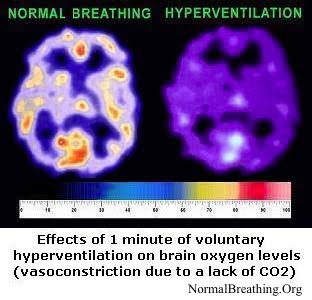
This is sensible since hypocapnia or over breathing reduces oxygen levels in body cells (see the image of the brain).
Ineffective breathing: the key cause of free radical damage
 Dozens of studies have shown that modern “normal subjects” breathe about 12 L/min at rest, while the medical norm is only 6 L/min. As a result, blood CO2 levels are less than normal. Arterial hypocapnia (CO2 deficiency) causes tissue hypoxia that triggers numerous pathological effects (see links with medical studies below).
There are additional adverse biochemical effects related to mouth breathing and chest breathing that also promote free radical damage and oxidative stress.
For most modern people, there is a particular time of the day when they have the lowest levels of oxygen in the brain and body cells. This is also the time when people generate the most free-radicals.
Sleep and free radical generation
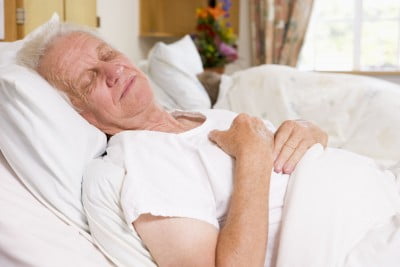 Most people feel the worst or most miserable in the morning. Furthermore, as mentioned above, severely sick, critically ill (due to heart attacks, seizures, acute asthma, strokes, etc.) and hospitalized patients are most likely to have severe episodes or even die during early morning hours (see medical research on web page Sleep Heavy Breathing Effect). The key reason for all these abnormalities is a low body oxygen level due to overbreathing with contributions of chest/mouth breathing. What are the effects? Hypoxic cells switch to anaerobic respiration and start producing lactic acid and other incompletely oxidized chemicals or free radicals, causing cellular stress and intensifying respiration.
While many people are concerned with free radicals in foods, water, and air, generally sick and severely people do not eat or drink anything during or just before night sleep. How do they cause oxidative stress then? They get free radicals and free radical damage due to their low oxygen levels in the body caused by heavy breathing and low levels of CO2 in the lungs.
 Over 175 medical doctors practicing the Buteyko breathing technique suggested that there are two thresholds for the body-oxygen test in relation to free radical generation:
- less than X seconds for the body-oxygen test (moderate degrees of chronic diseases)
- less than Y seconds (severe forms of chronic diseases).
Both these numbers X and Y are provided below as your bonus content.
- X is equal to 20 s (that corresponds to the mild body hypoxia, increased lactic acid, the spread of infections in the sinuses, lungs, and GI tract).
- Y is 10 s (for such states, there is no resistance from the immune system to bacteria in the blood – bacteremia can easily kill the person).
[/sociallocker]
Therefore, taking care of light and easy breathing 24/7 (and high body oxygen levels), especially during early morning hours, is a much smarter step to prevent free radical damage and increase body antioxidant defenses than to worry about diets, “natural” supplements and pills.
Related web pages:
- CO2: Cell Oxygen Levels are controlled by alveolar CO2 and breathing. Hyperventilation, regardless of the arterial CO2 changes, causes alveolar hypocapnia, which leads to cell hypoxia (low cell oxygen concentrations).
- CO2 and Chronic Inflammation – Hypocapnia caused by hyperventilation leads to hypoxia that promotes chronic inflammation.
Medical References
Veselá A, Wilhelm J., The role of carbon dioxide in free radical reactions of the organism, Physiol Res. 2002;51(4):335-9.
Kogan AKh, Grachev SV, Eliseeva SV, Bolevich S., [Carbon dioxide–a universal inhibitor of the generation of active oxygen forms [free radicals] by cells (deciphering one enigma of evolution)], Izv Akad Nauk Ser Biol. 1997 Mar-Apr;(2):204-17.
Kogan AKh, Grachev SV, Eliseeva SV, Bolevich S., [Ability of carbon dioxide to inhibit generation of superoxide anion radical in cells and its biomedical role], Vopr Med Khim. 1996 Jul-Sep;42(3):193-202.
Boljevic S, Kogan AH, Gracev SV, Jelisejeva SV, Daniljak IG., [Carbon dioxide inhibits the generation of active forms of oxygen in human and animal cells and the significance of the phenomenon in biology and medicine], Vojnosanit Pregl. 1996 Jul-Aug;53(4):261-74.
Daniliak IG, Kogan AKh, Sumarokov AV, Bolevich S., [Changes in the sensitivity of leukocytes to the inhibiting effect of CO2 on their generation of active forms of oxygen in bronchial asthma patients], Ter Arkh. 1995;67(3):23-6.
Kogan AKh, Bolevich S, Daniliak IG., [Comparative study of the effect of carbon dioxide on the generation of active forms of oxygen by leukocytes in health and in bronchial asthma], Patol Fiziol Eksp Ter. 1995 Jul-Sep;(3):34-40.