- Updated on October 29, 2020
 By Dr. Artour Rakhimov, Alternative Health Educator and Author
- Medically Reviewed by Dr. Andrés David Velasquez, MD and Naziliya Rakhimova, MD
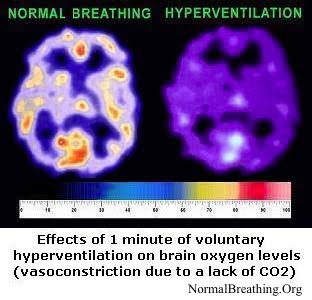 Vasodilator (definition) is a factor that causes an increase in the diameter of blood vessels. This mainly relates to dilation of small arteries and arterioles since they create the main resistance to the systemic blood flow in the human body (about 70%). A vasodilator can be:
1) a chemical substance such as from food (CO2 from carbohydrates, fats, and NO derived from arginine)
2) or various stimuli, such as reactive hyperemia (in skin and muscles), exercise hyperemia (muscle), whole body heating (skin) and mental stress (muscle).
Since over 90% of people breathe much more than the medical norm (see the Homepage for clinical studies), the main problem with vasodilators relate to ineffective breathing.
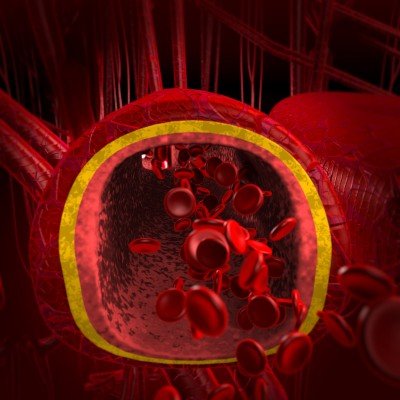 The most common application of vasodilators is to reduce blood pressure in people with hypertension and also treat conditions with poor circulation, such as chilblains and Raynaud’s syndrome (poor circulation in hands and feet). Insufficient and worsening perfusion of vital organs is a clinical feature in progressing cancer, diabetes, arthritis, hypothyroidism, CFS, and many other conditions.
The blood vessels are expanded either by relaxing the smooth muscles of the vessel walls (as occurs with CO2, nitric oxide, nitrates and calcium antagonists) or by changing nerve signals that control the tone of the blood vessels (as occurs with alpha-blockers).
CO2 and NO (nitric oxide): most potent natural vasodilators (from food)
“… Carbon dioxide, a most potent cerebral vasodilator, …” Djurberg HG, Tjan GT, Al Moutaery KR, Enhanced catheter propagation with hypercapnia during super-selective cerebral cauterization, Neuroradiology, 1998 Jul; 40(7): 466-8.
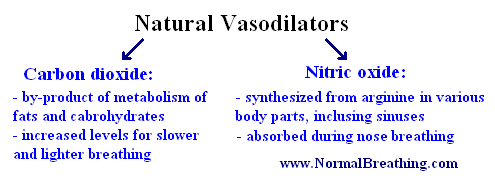
 In the right conditions, the human body can take care of normal blood flow to all organs and tissues due to the two most potent vasodilators naturally present in the blood and other cells due to food sources. These natural vasodilators are CO2 (carbon dioxide) and NO (nitric oxide).
Carbohydrates and fats are naturally present in food sources and contain carbon atoms that are oxidized to CO2. Nitric oxide is produced in various parts of the human body from arginine, an amino acid present in various food sources, especially meat, fish, and nuts. The action of nitroglycerine and many other drugs are based on the release of nitric oxide. Since sinuses are important sources of nasal NO, nose breathing and the normal unconscious breathing pattern (relatively sharp, but small and short inhalations with long and slow exhalations) are crucial for the utilization of nasal NO.
Mouth breathing (including during physical exercise) prevents absorption of nasal NO and also reduces arterial CO2 levels causing problems with most important vasodilators. Carbon dioxide losses occur due to hyperventilation which is very common in the sick and even “normal” modern subjects at rest (see links to medical studies below).
This YouTube video “Vasodilator and vasodilation” explains effects of the most potent vasodilator, carbon dioxide, on perfusion.
Physical activity and sports also have powerful vasodilating effects that last for many hours after a good workout. Decades ago, in the 1980s, one clinical study discovered that there is a certain duration of daily physical exercise that causes permanent dilation of blood vessels, with reduction of resting pulse, and other positive effects.
This study became famous among top athletes due to its great practical value. You can find out the exact minimum duration of daily physical exercise (to cause the lasting vasodilating effect) right below here as your bonus content.
You need to train for 2+ hours every day with mild aerobic or higher intensity.
[/sociallocker]
References: Vasodilator and Most Potent Vasodilators.