- Updated on October 29, 2020
 By Dr. Artour Rakhimov, Alternative Health Educator and Author
- Medically Reviewed by Naziliya Rakhimova, MD
Causes of Congested Nose
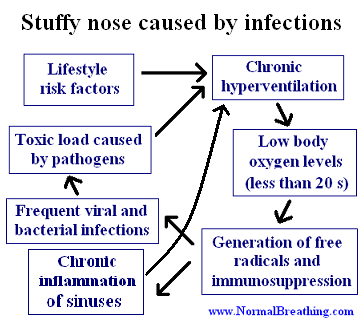 A stuffy nose (also known as “Congested Nose”) occurs only in conditions of low body-oxygen levels (less than 20 seconds for the body-oxygen test). Low cell-oxygen levels are caused by chronic overbreathing, upper chest breathing (which drastically reduces blood oxygenation), and habitual mouth breathing.

 While main superficial causes of congested nose include bacterial and viral infections, low body-oxygen content, on a cell level, is always the key factor. When nasal congestion is caused by infections, the person will notice that his or her mucus is yellow or green. This indicates the presence of dead bacteria or viruses in mucosal discharges.
A stuffy nose can also be caused by allergies or allergic reactions to some airborne substances (e.g., as in the case of hay fever). However, even in this case, the hypersensitive state of the immune system is caused by
chronic overbreathing. As you can see in the right diagram, the cause is the same, but the mucus is going to be clear.
Another possible cause of a large production of clear mucus is dairy products. Such allergic reactions occur due to either casein (the main protein in milk) or lactose (milk sugar).
Natural remedies for a stuffy nose due to allergies
If your congested nose is caused by allergic reactions, you need to avoid them. For example, you can test your reaction to dairy products by eliminating all dairy products from your diet for 3 days.
If you are allergic to tree pollen or cat or dog proteins, these airborne triggers are to be avoided. Once you achieve more than 30 seconds for the body-oxygen test, most of these substances (dust, dust mites, tree pollen, cat proteins, dog proteins, and so forth) will not produce an auto-immune response due to normalization of the immune system.
Natural remedies for congested nose due to infections
Most people with a stuffy nose can get a relief in 1 minute if they slow down their heavy breathing and increase body oxygenation using a simple breathing exercise. This very easy respiratory exercise to clear a stuffy nose was invented and used by more than 170 Soviet and Russian MDs. They taught this most natural remedy to 1,000’s of their patients with asthma, chronic mouth breathing, sinusitis, rhinitis, hay fever, and many other conditions. This natural treatment and remedy also work for pregnant women and children. The exercise can be applied during sleep (at night) as well: How to get rid of a congested nose” in about 1 minute.
Video: Stuffy Nose Remedy.
 If you slow down your basal breathing patterns (get closer to the medical norm for breathing at rest) and achieve more than a certain number (in seconds) for the body-oxygen test, your frequent upper respiratory infections will also disappear. Hay fever eradication usually requires a little higher numbers (by about 10 seconds) for the body-oxygen test and avoidance of all triggers for gradual desensitization of the immune system for about 2-3 months. You can find out these exact numbers (to cure nasal congestion and defeat hay fever) right below here as your bonus content.
You need to have 20 s for the CP test 24/7 in order to solve nasal congestion, and 30+ s all the time to eliminate hayfever.
[/sociallocker]