- Updated on September 13, 2020
 By Dr. Artour Rakhimov, Alternative Health Educator and Author
- Medically Reviewed by Naziliya Rakhimova, MD
Most Potent Bronchodilators to Treat Asthma and COPD Naturally
 A natural bronchodilator is a substance that relaxes smooth muscles or airways and causes dilation of bronchi and bronchioles. Bronchodilators reduce resistance in the respiratory tract and improve airflow to the alveoli of the lungs. Bronchodilators are divided as either endogenous or natural bronchodilators (originating naturally within the human body or from foods), or they may be medical drugs that are used for the treatment of breathing problems in people with COPD, asthma, cystic fibrosis, and other respiratory conditions. In order to find the most effective bronchodilators, consider the cause of bronchospasm in these people.
Hypocapnia: the chief cause of bronchoconstriction
Ventilation rates (chronic diseases)
| Condition | Minute ventilation |
Number of people |
All references or Click below for abstracts |
| Normal breathing | 6 L/min | – | Medical textbooks |
| Healthy Subjects | 6-7 L/min | >400 | Results of 14 studies |
| Asthma | 13 (+-2) L/min | 16 | Chalupa et al., 2004 |
| Asthma | 15 L/min | 8 | Johnson et al., 1995 |
| Asthma | 14 (+-6) L/min | 39 | Bowler et al., 1998 |
| Asthma | 13 (+-4) L/min | 17 | Kassabian et al., 1982 |
| Asthma | 12 L/min | 101 | McFadden, Lyons., 1968 |
| COPD | 14 (+-2) L/min | 12 | Palange et al., 2001 |
| COPD | 12 (+-2) L/min | 10 | Sinderby et al., 2001 |
| COPD | 14 L/min | 3 | Stulbarg et al., 2001 |
| Cystic fibrosis | 15 L/min | 15 | Fauroux et al., 2006 |
| Cystic fibrosis | 10 L/min | 11 | Browning et al., 1990 |
| Cystic fibrosis* | 10 L/min | 10 | Ward et al., 1999 |
| CF and diabetes* | 10 L/min | 7 | Ward et al., 1999 |
| Cystic fibrosis | 16 L/min | 7 | Dodd et al., 2006 |
| Cystic fibrosis | 18 L/min | 9 | McKone et al., 2005 |
| Cystic fibrosis* | 13 (+-2) L/min | 10 | Bell et al., 1996 |
| Cystic fibrosis | 11-14 L/min | 6 | Tepper et al., 1983 |
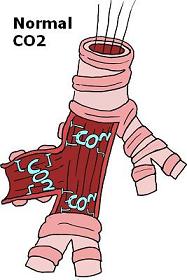 Sick people suffer from bronchoconstriction due to heavy breathing 24/7. Why? This is because they have too low levels of CO2 in airways.
Carbon dioxide is probably the most powerful among all bronchodilators since it is the most potent relaxant of smooth muscles and vasodilator (see links to studies below). Normal breathing parameters include 40 mm Hg CO2 pressure in the alveoli of the lungs to keep these air passages open wide (see on the left) due to natural bronchodilation, while hypocapnia (CO2 deficiency) in airways leads to bronchoconstriction or bronchospasm.
“Agents that tend to dilate airways include increased CO2 (hypoventilation or inspired CO2)…” Normal C. Straub, Sr., Professor Emeritus, the University of California at San Francisco School of Medicine; Textbook on physiology: Straub NC, Section V, The Respiratory System, in Physiology, eds. RM Berne & MN Levy, fourth edition, Mosby, St. Louis, 1998.
Carbon dioxide is listed in this medical textbook as the Number 1 bronchodilator. The human body generates CO2 by burning foods that contain carbs, fats, and other energy sources. When the CO2 level in the lungs is low (due to overbreathing that is present in over 95% of modern people – see the Homepage), the bronchi constrict (the right picture below: bronchoconstriction), causing wheezing, feelings of breathlessness, and difficulty breathing. These effects are mainly known to asthmatics and patients with bronchitis and emphysema (COPD conditions). Hence, bronchodilation is another carbon dioxide effect that is crucial for normal health.
Research about CO2 and asthma
 In 1968, in his research article, The mechanism of bronchoconstriction due to hypocapnia in man (“hypocapnia” means abnormally low CO2 concentrations) Sterling explained that carbon dioxide deficiency leads to an excited state of the cholinergic nerve (Sterling, 1968). Since this nerve is responsible for the tone or relaxation of the smooth muscles in bronchi, its excited state prevents bronchodilation.
Dr. Herxheimer was probably the first scientist who proposed that CO2 is a natural bronchodilator, while low CO2 is the cause of bronchial asthma. His articles Hyperventilation asthma and The late bronchial reaction in induced asthma were published in 1946 and 1952 (see references below).
Soviet Doctor K Buteyko independently proposed this link in the 1950s (his first publication was in 1964) when he discovered that CO2 is among potent natural bronchodilators and overbreathing in the development and degree of COPD and asthma (Buteyko, 1964).
He and his colleagues also found that asthma patients got immediate relief from their asthma attack symptoms if they practiced reduced breathing exercise, which is the main exercise of the Buteyko breathing therapy. Indeed, as soon as a person with bronchoconstriction starts to breathe less, their carbon dioxide level in alveoli rises, and this leads to bronchodilation.
Correction of causes of hyperventilation is also necessary in order to permanently normalize one’s breathing and alveolar carbon dioxide levels to ensure the effects of this natural bronchodilator. This is the most logical and natural treatment and relief from asthma.
Hence, hypercapnic bronchoconstriction or bronchospasm is the law of physiology, while CO2 is the most powerful natural bronchodilator.
The video on the right side (“Hyperventilation and Natural Bronchodilators“) features Dr. Artour Rakhimov. He explains the most important natural bronchodilators.
The nasal nitric oxide is another natural bronchodilator if you are a nose breather
Nitric oxide is also a bronchodilator (see the study done in the Harvard Medical School Bronchodilator Action of Inhaled Nitric Oxide in Guinea Pigs). NO (nitric oxide) is produced in different parts of the human body, including sinus passages. It is also food-related since arginine, an amino acid, is required to produce nitric oxide. Many foods, such as meat, fish, eggs, nuts, etc. are high in arginine.
Mouth breathing prevents the absorption of nasal nitric oxide and causes additional problems due to the spread of pathogens since nitric oxide has powerful antiviral and antibacterial properties. Therefore, CO2 and NO are the most effective natural bronchodilators.
This website provides details of reduced breathing exercises and lifestyle changes that slow down breathing and naturally increase CO2 levels in airways, causing dilation of airways. However, there are some special breathing methods that are clinically proven and more effective (by nearly twice). The names of these methods are provided as your bonus content right down here.
These are the Frolov and DIY breathing devices. For people with lung problems, these devices are nearly twice more effective than Buteyko exercises.
[/sociallocker]
– This page in Spanish: La mayoría de los broncodilatadores potentes tratan naturalmente el asma y la EPOC.
References
Buteyko KP, An Instruction for VBN Therapy for Bronchial Asthma, Angina Pectoris, High Blood Pressure and Obliterating Endarteritis: Preprint. – Novosibirsk, 1964.
Herxheimer H., Hyperventilation asthma, Lancet 1946, 6385: p. 83-87.
Herxheimer H., The late bronchial reaction in induced asthma, Int Arch Allergy Appl Immunol 1952; 3: p. 323-328.
Sterling GM., The mechanism of bronchoconstriction due to hypocapnia in man, Clin Sci 1968 Apr; 34(2): 277-285.
Straub NC, Section V, The Respiratory System, in Physiology, eds. RM Berne & MN Levy, 4-th edition, Mosby, St. Louis, 1998.