- Updated on July 31, 2019
 By Dr. Artour Rakhimov, Alternative Health Educator and Author
The ineffective breathing pattern is a term that is often used in medical articles for nurses in order to describe a breathing pattern with reduced respiratory rate and reduced tidal volume as if this is the main respiratory problem for people with chronic health problems. Other people may imply that this term can also relate to chest breathing or mouth breathing.
Usually, such articles about ineffective breathing pattern (intended for nurses) do not provide any clinical evidence or references. What do we know about breathing in the sick? Do they indeed breathe too little air and require increased ventilation?
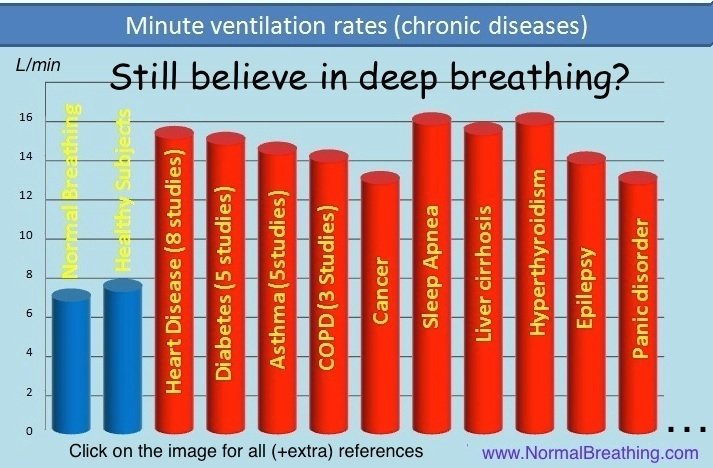
 A typical respiratory rate in the sick is about 15-20 breaths/min and the tidal volume is about 700-900 mL. When patients get even sicker, their respiratory rate is even higher, while the tidal volume may get reduced.
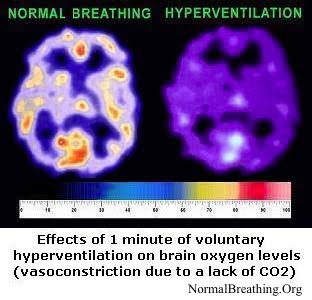
Therefore, we see that the term “ineffective breathing pattern” is used to confuse nurses with an attempt to promote an idea that sick people do not get enough oxygen because they breathe too little air. The real story is the opposite. They do not get enough O2 in their cells due to hyperventilation. There is no evidence that sick people and even severely sick people commonly breathe too little air (hypoventilation).
Cases with reduced ventilation or hypoventilation do exist, but they are rare. Hypoventilation normally leads to alveolar hypercapnia and arterial hypercapnia which can easily be confirmed by arterial CO2 measurements.
Over 95% of sick people suffer from too heavy and fast breathing that is the real ineffective breathing pattern. Let us consider it in more detail.
 For sick people, with their ineffective breathing pattern, the duration of inhalations and exhalations, breathing rate, amount of air inhaled per breath and other parameters are individual. Many sick people can have the following parameters of their breathing cycle (see the Figure below):
– inhalation (about 1.5-2 s)
– exhalation (1.5-2 s)
– no automatic pause (2 s in healthy subjects)
– the depth of inhalation or tidal volume is about 700-1,000 ml instead of 500-600 ml (the clinical norm)
– the respiratory rate is 15-20 breaths/min (usually over 25 breaths/min for the severely sick) instead of the normal 12 breaths/min at rest for a 70-kg person
– the body oxygen level (found with a special DIY breath holding time test) is less than 20 s. Hence, they breathe too deep and too fast in comparison with the normal breathing pattern.
There are 2 common aggravating factors of the ineffective breathing pattern, apart from hyperventilation, that drastically reduces O2 transport: mouth breathing and chest breathing. (For their effects, see links below.)
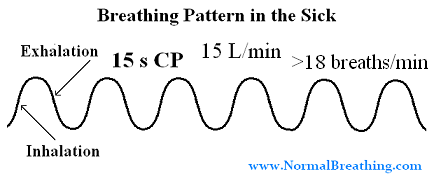
Fig. Ineffective breathing pattern, typical for the sick: deep and heavy breathing pattern; deep, forceful, and fast inhalations and exhalations, no automatic pause. Hypocapnia (CO2 deficiency) reduces blood oxygenation and the CP (cells oxygen level).
 Hence, all medical evidence and clinical experience show that sick people, with chronic health problems, have a heavy and deep ineffective breathing pattern.
This video clip from YouTube (Breathing Patterns and Buteyko Oxygen Test (Buteyko Technique) explains the link between the ineffective breathing pattern (present in most sick people) and body oxygenation test results.