- Updated on July 29, 2023
 By Dr. Artour Rakhimov, Alternative Health Educator and Author
- Medically Reviewed by Naziliya Rakhimova, MD
Breathing slower and less: the greatest health discovery ever
Yet, to my knowledge, it is one of the most challenging health therapies since the students are required to make changes in their automatic (or unconscious) breathing patterns in the right direction. Which direction?
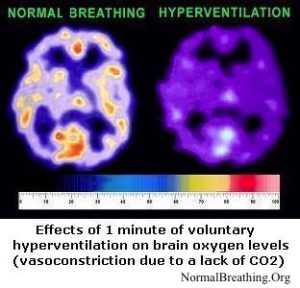 While breathing 2-3 times more than the medical norm, most people believe that they have good or “normal” breathing.
Some of them even say that their breathing is barely noticeable. But normal breathing is so tiny that healthy people experience virtually no sensations in relation to their breathing at rest.
Over 90% of modern people suffer from breathing problems. The common problems include chest breathing, mouth breathing, and hyperventilation (increased minute ventilation). All of these factors reduce oxygen levels in body cells and promote chronic diseases.
Minute ventilation rates (chronic diseases)
| Condition | Minute ventilation |
Number of people |
All references or click below for abstracts |
| Normal breathing | 6 L/min | – | Medical textbooks |
| Healthy Subjects | 6-7 L/min | >400 | Results of 14 studies |
| Heart disease | 15 (+-4) L/min | 22 | Dimopoulou et al, 2001 |
| Heart disease | 16 (+-2) L/min | 11 | Johnson et al, 2000 |
| Heart disease | 12 (+-3) L/min | 132 | Fanfulla et al, 1998 |
| Heart disease | 15 (+-4) L/min | 55 | Clark et al, 1997 |
| Heart disease | 13 (+-4) L/min | 15 | Banning et al, 1995 |
| Heart disease | 15 (+-4) L/min | 88 | Clark et al, 1995 |
| Heart disease | 14 (+-2) L/min | 30 | Buller et al, 1990 |
| Heart disease | 16 (+-6) L/min | 20 | Elborn et al, 1990 |
| Pulm hypertension | 12 (+-2) L/min | 11 | D’Alonzo et al, 1987 |
| Cancer | 12 (+-2) L/min | 40 | Travers et al, 2008 |
| Diabetes | 12-17 L/min | 26 | Bottini et al, 2003 |
| Diabetes | 15 (+-2) L/min | 45 | Tantucci et al, 2001 |
| Diabetes | 12 (+-2) L/min | 8 | Mancini et al, 1999 |
| Diabetes | 10-20 L/min | 28 | Tantucci et al, 1997 |
| Diabetes | 13 (+-2) L/min | 20 | Tantucci et al, 1996 |
| Asthma | 13 (+-2) L/min | 16 | Chalupa et al, 2004 |
| Asthma | 15 L/min | 8 | Johnson et al, 1995 |
| Asthma | 14 (+-6) L/min | 39 | Bowler et al, 1998 |
| Asthma | 13 (+-4) L/min | 17 | Kassabian et al, 1982 |
| Asthma | 12 L/min | 101 | McFadden, Lyons, 1968 |
| COPD | 14 (+-2) L/min | 12 | Palange et al, 2001 |
| COPD | 12 (+-2) L/min | 10 | Sinderby et al, 2001 |
| COPD | 14 L/min | 3 | Stulbarg et al, 2001 |
| Sleep apnea | 15 (+-3) L/min | 20 | Radwan et al, 2001 |
| Liver cirrhosis | 11-18 L/min | 24 | Epstein et al, 1998 |
| Hyperthyroidism | 15 (+-1) L/min | 42 | Kahaly, 1998 |
| Cystic fibrosis | 15 L/min | 15 | Fauroux et al, 2006 |
| Cystic fibrosis | 10 L/min | 11 | Browning et al, 1990 |
| Cystic fibrosis* | 10 L/min | 10 | Ward et al, 1999 |
| CF and diabetes* | 10 L/min | 7 | Ward et al, 1999 |
| Cystic fibrosis | 16 L/min | 7 | Dodd et al, 2006 |
| Cystic fibrosis | 18 L/min | 9 | McKone et al, 2005 |
| Cystic fibrosis* | 13 (+-2) L/min | 10 | Bell et al, 1996 |
| Cystic fibrosis | 11-14 L/min | 6 | Tepper et al, 1983 |
| Epilepsy | 13 L/min | 12 | Esquivel et al, 1991 |
| CHV | 13 (+-2) L/min | 134 | Han et al, 1997 |
| Panic disorder | 12 (+-5) L/min | 12 | Pain et al, 1991 |
| Bipolar disorder | 11 (+-2) L/min | 16 | MacKinnon et al, 2007 |
| Dystrophia myotonica | 16 (+-4) L/min | 12 | Clague et al, 1994 |
Note that advanced stages of asthma can lead to lung destruction, ventilation-perfusion mismatch,
and arterial hypercapnia causing a further reduction in body oxygen levels.
Breathing parameters in ordinary people are slightly better. However, this is much worse than it was during the first decades of the 20th century.

“Hence, normal breathing corresponds to a healthy organism” Dr. K. P. Buteyko, Dr. Buteyko’s Lecture in the Moscow State University on 9 December 1969.
Among the main causes of over-breathing in the modern population are drastic changes in diet and a lack of physical exercise with 100% nose breathing.
During the 1960’s-70’s, consumption of carbohydrates (both, sugars and starches) was dramatically increased, the Food Pyramid was invented and became popular, and dietary fats became enemies.
This website has over 500 web pages. It is based on hundreds of clinical studies quoted here. It is very possible that you can improve your health, become free from your medical problems, and achieve normal or even superior fitness following the ideas described on this website.
To navigate this site, use the main menu above and the submenu on the left side. There are also several major categories with their own menus at the bottom of each page.
Best ever-known clinical trials on asthma and cancer: breathing exercises
The best ever clinical trials on cancer (6 times less mortality for an experimental group with metastatic cancer) and asthma (over 90% reduction in medication in 6 independent Western trials) involved the same breathing exercises of one breathing technique.
This breathing technique is officially approved by one Ministry of Health and the BTS (British Thoracic Society) to treat asthma. In fact, in 2015 the BTS provided an A++ score to this breathing technique for the treatment of asthma.
This is far better than meditation, any yoga modality, or any other alternative health option. The team of over 150 medical doctors also had successful clinical pilot trials (approbations) of the same therapy on people with hypertension, radiation disease, hepatitis B, liver cirrhosis, and even HIV-AIDS.
The bonus content provides the name of this legendary breathing technique and links to these astonishing results.
The name of this therapy is the “Buteyko breathing method”.
See also the best cancer trial and all Buteyko clinical trials.
[/sociallocker]
Natural lifestyle choices before and after breathing retraining
| Lifestyle factor: | Body oxygen < 30 s | Body oxygen > 50 s |
| Energy level | Medium, low, or very low | High |
| Desire to exercise | Not strong, but possible | Craving and joy of exercise |
| Intensive exercise with nose breathing | Hard or impossible | Easy and effortless |
| Typical mind states | Confusion, anxiety, depression | Focus, concentration, clarity |
| Craving for sugar and junk foods | Present | Absent |
| Addictions to smoking, alcohol, and drugs | Possible | Absent |
| Desire to eat raw foods | Weak and rare | Very common and natural |
| Correct posture | Rare and requires efforts | Natural and automatic |
| Sleep | Often of poor quality; > 7 hours | Excellent quality; < 5 hours naturally |
While this breathing technique and its breathing exercises may sound new to most people, they are in fact over 5,000 years old. You can find out the same and similar meditation and mindfulness breathing exercises in the ancient Sanskrit texts.
See our latest music for meditation album on YouTube.
This site also offers effective natural home remedies to get rid of a stuffy nose, stop coughing (even at night), relieve constipation and fall asleep fast using the reduced breathing meditation exercise and lifestyle techniques.
The typical success rates for these remedies are about 80-90%, and these methods work in 1-3 minutes since they address the cause of symptoms and health problems. Check out the side link for specific solutions.
Comments are closed on the Homepage but are available on nearly 400 other breathing pages.
– This page in Spanish: La Respiración Normal Vence a las Enfermedades Crónicas
– This page in German: www.atmung.org.