- Updated on October 29, 2020
 By Dr. Artour Rakhimov, Alternative Health Educator and Author

Persistent Cough Remedies: Easy Breathing Exercises
Persistent Cough remedies include an easy breathing exercise developed and used by more than 170 Soviet and Russian medical doctors. This exercise calms down urge-to-cough receptors and increases body-O2 content. It works well even at night. An additional cause of a persistent cough is chronic inflammation due to positive body voltage. This problem can be solved by normalization of the electrical voltage of the human body.
Why do people with asthma, bronchitis, COPD, cystic fibrosis and some other conditions suffer from persistent coughing?
Ventilation rates (chronic diseases)
| Condition | Minute ventilation |
Number of people |
All references or click below for abstracts |
| Normal breathing | 6 L/min | – | Medical textbooks |
| Healthy Subjects | 6-7 L/min | >400 | Results of 14 studies |
| Asthma | 13 (+-2) L/min | 16 | Chalupa et al, 2004 |
| Asthma | 15 L/min | 8 | Johnson et al, 1995 |
| Asthma | 14 (+-6) L/min | 39 | Bowler et al, 1998 |
| Asthma | 13 (+-4) L/min | 17 | Kassabian et al, 1982 |
| Asthma | 12 L/min | 101 | McFadden, Lyons, 1968 |
| COPD | 14 (+-2) L/min | 12 | Palange et al, 2001 |
| COPD | 12 (+-2) L/min | 10 | Sinderby et al, 2001 |
| COPD | 14 L/min | 3 | Stulbarg et al, 2001 |
| Cystic fibrosis | 15 L/min | 15 | Fauroux et al, 2006 |
| Cystic fibrosis | 10 L/min | 11 | Browning et al, 1990 |
| Cystic fibrosis* | 10 L/min | 10 | Ward et al, 1999 |
| CF and diabetes* | 10 L/min | 7 | Ward et al, 1999 |
| Cystic fibrosis | 16 L/min | 7 | Dodd et al, 2006 |
| Cystic fibrosis | 18 L/min | 9 | McKone et al, 2005 |
| Cystic fibrosis* | 13 (+-2) L/min | 10 | Bell et al, 1996 |
| Cystic fibrosis | 11-14 L/min | 6 | Tepper et al, 1983 |
The chart below explains the mechanism of persistent coughing: it is a self-perpetuating activity that naturally leads to more persistent coughing unless one learns how to cough correctly without a reduction in the body and brain O2 content and without creating more inflammation.

Cough-gone remedies instructions
Most natural remedies for persistent cough
Remedy No. 1. Learn how to cough only through the nose (i.e., with your mouth closed all the time). It will help you to reduce irritation of airways and bronchospasm and will increase oxygen levels in body cells and the brain.
Remedy No. 2. After you have mastered Remedy No. 1 (it may take 1-2 days), learn how to cough with the mouth and nose closed. You simply need to keep the mouth closed and the nose pinched. This will further increase your body and brain oxygenation.
These 2 easiest remedies for chronic coughing are often sufficient to stop or reduce bouts of persistent coughing and gradually to recover. However, you can subdue coughing even faster if you use the most potent anti-coughing breathing exercise called “reduced breathing“.
Remedy No. 3. Sit down in a comfortable position, preferably at an ordinary table, on a straight chair. While having the bout of coughing, try your best to relax and at the end of your usual exhalation, pinch your nose and hold your breath (the mouth should be closed all the time) until you experience moderate discomfort.
If you cannot hold your breath due to severe coughing, pinch your nose and keep your mouth closed while coughing without any air exchange. Why? Your goal is to increase the CO2 content in your airways so that you calm down the cough-receptor cells that become irritated due to several mechanical and biochemical factors during acute-coughing bouts. These nerve cells stimulate the breathing center in the brain both to initiate and to continue coughing.
After the breath hold, when you get a moderate or distinctive desire to take a breath, take only a small (or short) inhalation (one small sniff) and do it only through your nose. After this small inhalation, focus on relaxing all body muscles again, especially in the upper chest and shoulders, in order to exhale slowly. If coughing is present, your goal is to limit your air or gas exchange to very small amounts. Ideally, the exhalation must be natural and unforced. Then take another (smaller) inhalation and again completely relax to exhale.
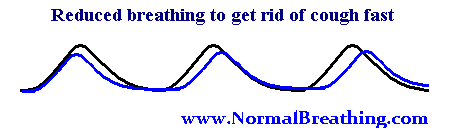
With each breath, your goal is to take a small or reduced inhalation and then completely relax even though you still have a cough. You should gradually create a more-distinctive-air hunger while relaxing your body muscles. You will soon experience a strong desire to breathe more. Maintain this desire until your coughing subsides.
Your breathing can be quite frequent during this reduced breathing exercise (with frequent short inhalations). If you do the exercise correctly (you will breathe up to 30-50% less air while being relaxed), you will notice 2 signs:
– Your arms and feet will get warm in about 1 minute after starting this exercise
– The nasal passages will become more open and moist in about the same 1-2 minutes.
The permanent remedy for a persistent cough
 After testing thousands of their patients, the Russian medical doctors (who developed this exercise) found that a persistent cough is possible only in those people who have at least twice less oxygen in body cells (measured in seconds using the DIY body-oxygen test). As a result, the permanent remedy for chronic coughing is to slow down the unconscious- or automatic-breathing pattern closer to the medical norm. With more than X seconds for the body oxygenation test, coughing disappears completely. You can find this magic number X in the next paragraph as your bonus content.
You need to get over 25 seconds for the CP test to be free from coughing.
[/sociallocker]
This breathing exercise is among the most powerful cough remedies.
An additional cough remedy is grounding the human body to achieve the same negative electrical potential as Earth (free electrons reduce inflammation). This method is explained on the page Earthing.
Nearly all people experience complete relief from coughing when they achieve more than 30 seconds for the body-oxygen test 24/7. This is the ultimate cough remedy, achievable with application of those breathing exercises and lifestyle changes that increase body O2.
Belvisi MG, Geppetti P, Current and future drugs for the treatment of chronic cough, Thorax, 2004 May;59(5):438-40.
Schroeder K, Fahey T, Should we advise parents to administer over the counter cough medicines for acute cough? Systematic review of randomised controlled trials, Arch Dis Child. 2002 Mar;86(3):170-5.
Schroeder K, Fahey T, Systematic review of randomised controlled trials of over the counter cough medicines for acute cough in adults, BMJ. 2002 Feb 9;324(7333):329-31.
Smith SM, Schroeder K, Fahey T, Over-the-counter medications for acute cough in children and adults in ambulatory settings, Cochrane Database Syst Rev. 2008 Jan 23;(1): CD001831.
Dicpinigaitis PV, Cough: an unmet clinical need, Br J Pharmacol. 2011 May;163(1):116-24.
Eccles R, Mechanisms of the placebo effect of sweet cough syrups, Respir Physiol Neurobiol. 2006 Jul 28;152(3):340-8.
Dicpinigaitis PV, Colice GL, Goolsby MJ, Rogg GI, Spector SL, Winther B, Acute cough: a diagnostic and therapeutic challenge, Cough. 2009 Dec 16;5:11.
Mazzone SB, McGovern AE, Sensory neural targets for the treatment of cough, Clin Exp Pharmacol Physiol. 2007 Oct;34(10):955-62.
Barnes PJ, The problem of cough and development of novel antitussives, Pulm Pharmacol Ther. 2007;20(4):416-22.